Flame Nebula
Videos
The Flame Nebula is an emission nebula in the constellation Orion. Alternatively, it is designated as NGC 2024 and Sh2-277. It is about 1350 light-years away. At that distance, the Flame Nebula lies w
The Flame Nebula in visible light (broadband). The star above it is Alnitak. The nebulae to the upper left are IC 431 and IC 432.


The center of the Flame Nebula seen by JWST NIRCam, revealing proplyds in new detail and revealing two new candidates.

Optical image in B, V and R filters, from La Silla Observatory

Infrared image, from 2MASS
The Orion molecular cloud complex is a star-forming region with stellar ages ranging up to 12 Myr. Two giant molecular clouds are a part of it, Orion A and Orion B. The stars currently forming within
Flame Nebula
…designated as NGC 2024 and Sh2-277. It is about 1350 light-years away. At that distance, the Flame Nebula lies within the Orion B cloud of the larger Orion Molecular Cloud Complex. The bright star Alnitak (ζ Ori), the easternmost star in the Belt of Orion, appears very close to the Flame Nebula in the sky. But the star and nebula…
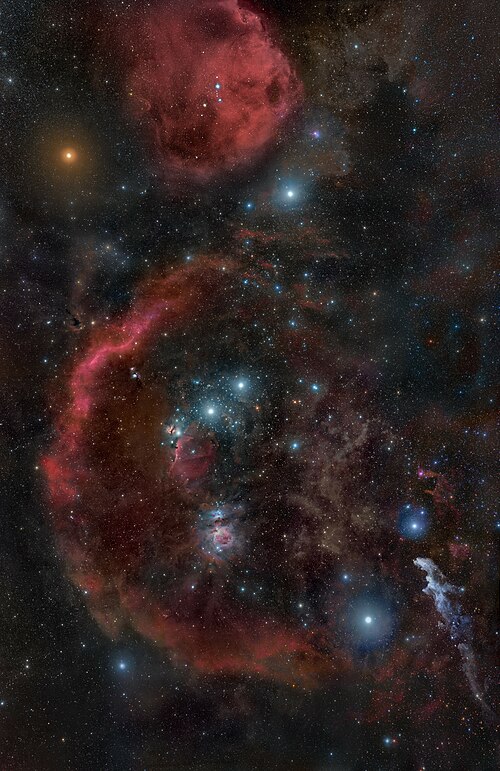
Part of the Orion molecular cloud complex, with the Great Nebula in Orion near the center, along with the Belt of Orion, and Barnard's Loop curling around the image

Young stars in Orion A and Orion B molecular clouds. The clouds were imaged by Herschel and the newborn stars were imaged by ALMA and the VLA.

Position of the Orion Molecular Clouds

HII regions (red) and molecular clouds (green to blue) in the Orion–Eridanus Superbubble seen by the Northern Sky Narrowband Survey. The reflection nebulae in the northwestern (upper right) part of the image belong to molecular clouds in Taurus.