Flame detector
Videos
Photos
A flame detector is a sensor designed to detect and respond to the presence of a flame or fire, allowing flame detection. Responses to a detected flame depend on the installation, but can include sounding an alarm, deactivating a fuel line, and activating a fire suppression system. When used in applications such as industrial furnaces, their role is to provide confirmation that the furnace is working properly; it can be used to turn off the ignition system though in many cases they take no direct action beyond notifying the operator or control system. A flame detector can often respond faster and more accurately than a smoke or heat detector due to the mechanisms it uses to detect the flame.

Flame detector type regions

Flame igniter (top) and flame sensor

Emission of radiation

Sunlight transmission
Flame
Videos
Photos
A flame is the visible, gaseous part of a fire. It is caused by a highly exothermic chemical reaction taking place in a thin zone. When flames are hot enough to have ionized gaseous components of sufficient density, they are then considered plasma.

Flames of charcoal

Different flame types of a Bunsen burner depend on oxygen supply. On the left a rich fuel with no premixed oxygen produces a yellow sooty diffusion flame; on the right a lean fully oxygen premixed flame produces no soot and the flame color is produced by molecular radicals, especially CH and C2 band emission.
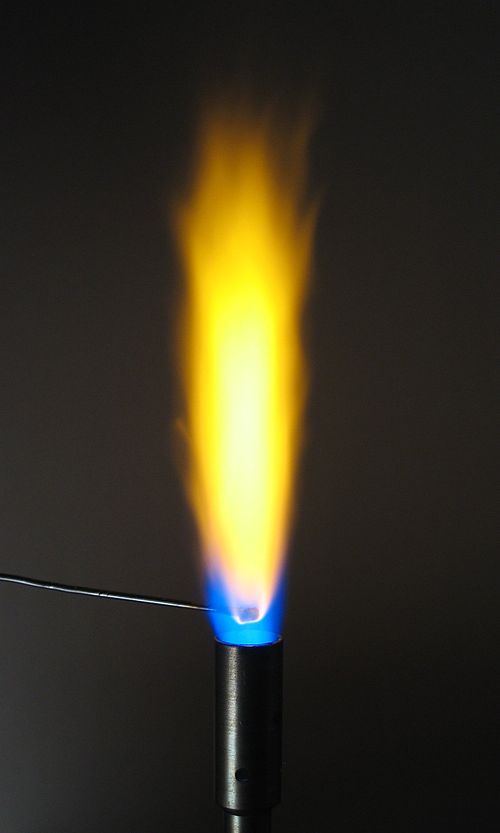
A flame test for sodium. The yellow color in this gas flame does not arise from the black-body emission of soot particles (as the flame is clearly a blue premixed complete combustion flame) but instead comes from the spectral line emission of sodium atoms, specifically the very intense sodium D lines.

In zero-G, convection does not carry the hot combustion products away from the fuel source, resulting in a spherical flame front.