Fourteen Points
Videos
The Fourteen Points was a statement of principles for peace that was to be used for peace negotiations in order to end World War I. The principles were outlined in a January 8, 1918, speech on war aim
U.S. president Woodrow Wilson in a 1918 portrait


President Wilson tells George Washington that he destroys autocracy with his 14 points.

Wilson's Fourteen Points as the only way to peace for German government, American political cartoon, 1918.

1926 German artwork made with Notgeld coins depicting "The World-Juggler with 14 Points;" Clemenceau and Lloyd George light bombs.
The Armistice of 11 November 1918 was the armistice that ended fighting on land, at sea, and in the air in World War I between the Entente and their last remaining opponent, Germany. It was signed in
Fourteen Points
…The good Lord had only ten!" (Le bon Dieu n'en avait que dix !). As a major public statement of war aims, it became the basis for the terms of the German surrender at the end of the First World War. After the speech, Colonel House worked to secure the acceptance of the Fourteen Points by Entente leaders. On October 16, 1918, President Woodrow…

Photograph taken after reaching agreement for the armistice that ended World War I. This is Ferdinand Foch's own railway carriage in the Forest of Compiègne. Foch's chief of staff Maxime Weygand is second from left. Third from the left is the senior British representative, Sir Rosslyn Wemyss. Foch is second from the right. On the right is Admiral Sir George Hope.

German prisoners of war captured near Amiens in late August 1918

Hindenburg, Kaiser Wilhelm and Ludendorff in discussion at the General Headquarters in Pleß Castle, in Silesia (modern-day Pszczyna, Poland).
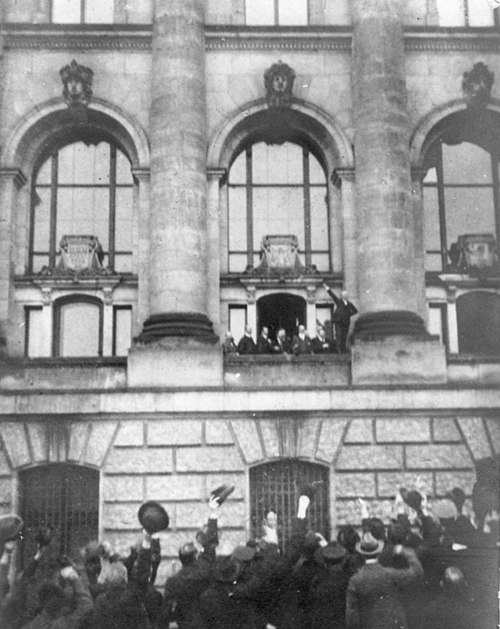
The declaration of the Republic at the Reichstag building on 9 November