Francisco Goya
Videos
Francisco José de Goya y Lucientes was a Spanish romantic painter and printmaker. He is considered the most important Spanish artist of the late 18th and early 19th centuries. His paintings, drawings,
Portrait by Vicente López Portaña, 1826


Yard with Lunatics, c. 1794

Birth house of Francisco Goya, Fuendetodos, Zaragoza

Portrait of Josefa Bayeu (1747–1812)
La maja desnuda
Videos
The Naked Maja or The Nude Maja is an oil-on-canvas painting made around 1797–1800 by the Spanish artist Francisco Goya, and has been in the Museo del Prado in Madrid since 1901. It portrays a nude wo
Francisco Goya
…Primer Pintor de Cámara (Prime Court Painter), the highest rank for a Spanish court painter. In the late 1790s, commissioned by Godoy, he completed his La maja desnuda, a remarkably daring nude for the time and clearly indebted to Diego Velázquez. In 1800–01, he painted Charles IV of Spain and His Family, also influenced…

Goya Maja naga 2

La maja vestida, c. 1803. Museo del Prado, Madrid.

Diego Velázquez, Rokeby Venus, c. 1647–51. National Gallery, London.
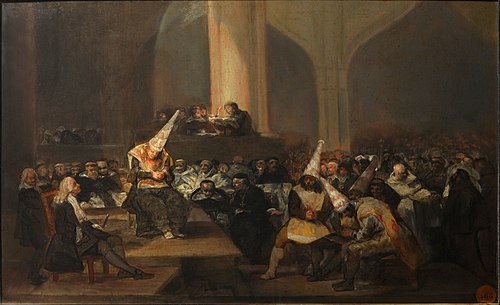
Goya, The Inquisition Tribunal, c. 1808–12. Goya detested the inquisition and depicted it in harsh terms a number of times, and satirised it in works such as his c. 1820–1823 Witches' Sabbath.