French Resistance
Videos
The French Resistance was a resistance movement made of a collection of different revolutionary groups that fought the Nazi occupation and the collaborationist Vichy regime in France during the Second

Members of the Maquis near Boulogne-sur-Mer in September 1944

The cemetery and memorial in Vassieux-en-Vercors where, in July 1944, German Wehrmacht forces executed more than 200 people, in reprisal for the Maquis's armed resistance. The town was later awarded the Ordre de la Libération.

Identity document of French Resistance fighter Lucien Pélissou

The ruins of Oradour-sur-Glane, in the Limousin region of the Massif Central
The French Forces of the Interior were French resistance fighters in the later stages of World War II. Charles de Gaulle used it as a formal name for the resistance fighters. The change in designation
French Resistance
…After the Allied landings in Normandy and Provence, the paramilitary components of the Resistance formed a hierarchy of operational units known as the French Forces of the Interior (FFI) with around 100,000 fighters in June 1944. By October 1944, the FFI had grown to 400,000 members. Although the amalgamation of the FFI was sometimes…

The Cross of Lorraine on the flag of the 2nd company, 1st battalion, FFI Finistere. It was founded by a group of French Scouts who joined the French Resistance in June 1940. The group carried out intelligence missions and the repatriations of allied airmen. In February 1944 it became part of the FFI and participated in the liberation of Quimper on August 8, 1944.

FFI and Vercors Republic marked captured truck during the battle for Paris (1944), on exhibition during the 60th anniversary celebrations of the liberation.
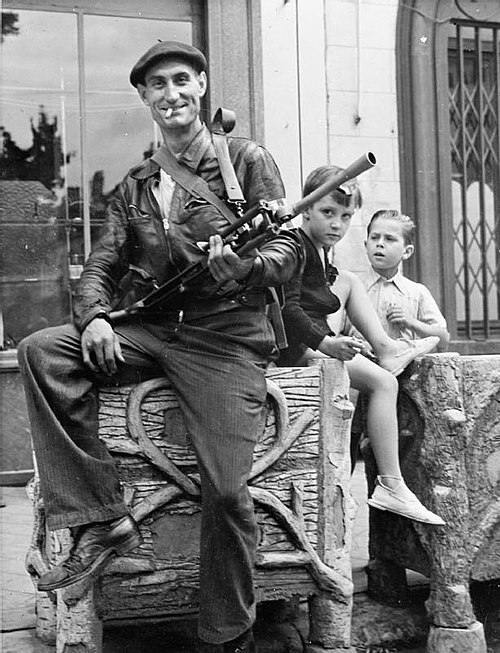
Member of the FFI in Châteaudun with a Bren gun.