Gaia
Videos
In Greek mythology, Gaia, also spelled Gaea, is the personification of Earth. She is the mother of Uranus, with whom she conceived the Titans, the Cyclopes, and the Giants, as well as of Pontus, from

Gaia pleading for her sons the Gigantes (Giants), detail of the Gigantomachy frieze, Pergamon Altar, Pergamon museum, Berlin
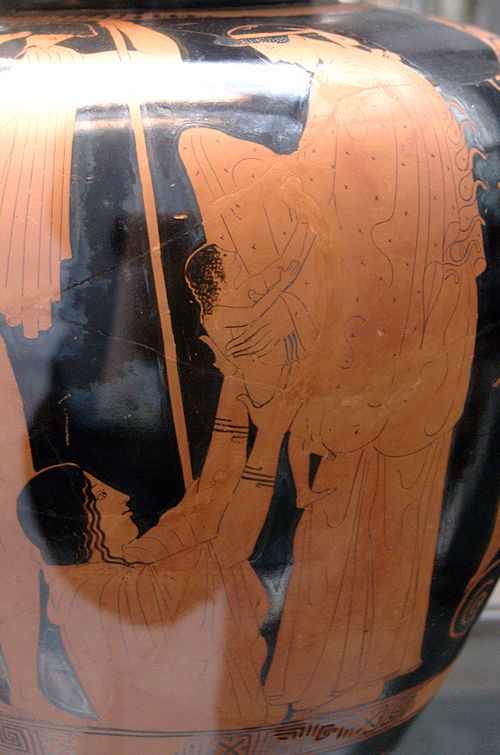
Gaia hands her newborn, Erichthonius, to Athena as Hephaestus watches – an Attic red-figure stamnos, 470–460 BC

Although typically associated with Dione and Aphrodite, one interpretation holds that these sculptures from the east pediment of the Parthenon depict Thalassa (the Sea) in the lap of Gaia; c. 438-432 BC, British Museum.

Gaia entrusts Erichthonios to Athena. From left to right: Hephaestus, Athena, Erichthonios, Gaia, Aphrodite. Said to come from the temple of Hephaestus in Athens. Pentelic marble. 100–150 AD. Louvre
Hesiod
Videos
Hesiod was an Ancient Greek poet generally thought to have been active between 750 and 650 BC, around the same time as Homer.
Gaia
…In Mycenean Greek Ma-ka (probably transliterated as Ma-ga, "Mother Gaia") also contains the root ga-. Hesiod's Theogony tells how, after Chaos, "wide-bosomed" Gaia (Earth) arose to be the everlasting seat of the immortals who possess Olympus above. And after…

A possible imaginative depiction of Hesiod (Roman copy of a Greek original)
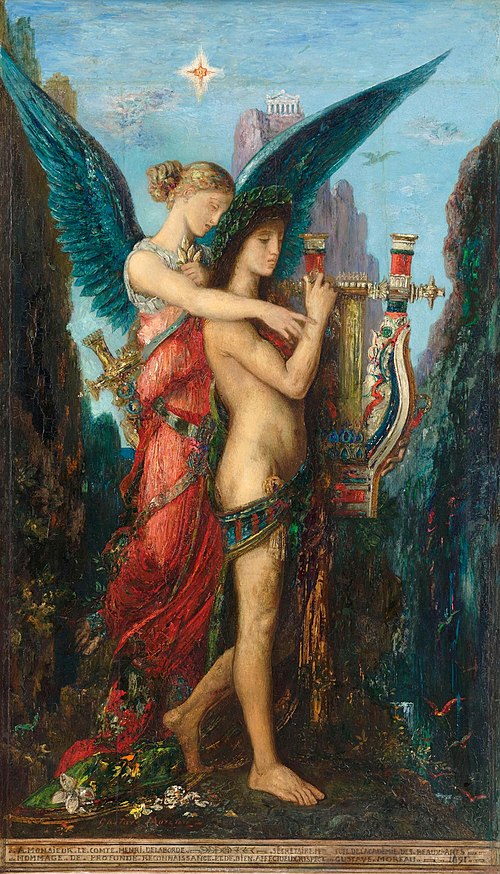
Hesiod and the Muse (1891), by Gustave Moreau. The poet is presented with a lyre, in contradiction to the account given by Hesiod himself, in which the gift was a laurel staff.

The Dance of the Muses at Mount Helicon by Bertel Thorvaldsen (1807). Hesiod cites inspiration from the Muses while on Mount Helicon.

Modern Mount Helicon. Hesiod once described his nearby hometown, Ascra, as "cruel in winter, hard in summer, never pleasant."