Ganges Chasma
Videos
Ganges Chasma is a deep canyon at the eastern end of the vast Valles Marineris system on Mars, an offshoot of Capri Chasma, and is in the Coprates quadrangle. It is named after the River Ganges in Sou

Cliff in northern wall of Ganges Chasma, as seen by THEMIS. Click on image to see relationship with other features in the Coprates region.
Noachian
Videos
The Noachian is a geologic system and early time period on the planet Mars characterized by high rates of meteorite and asteroid impacts and the possible presence of abundant surface water. The absolu
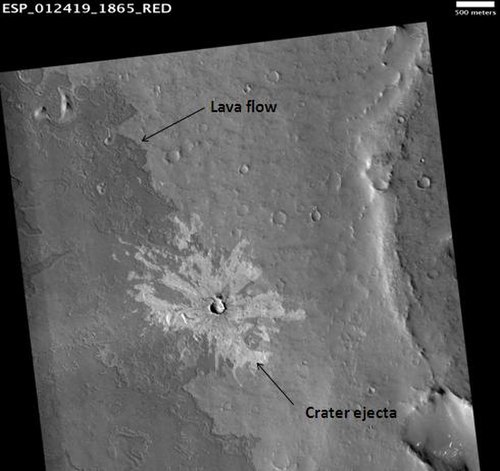
HiRISE image illustrating superpositioning, a principle that lets geologists determine the relative ages of surface units. The dark-toned lava flow overlies (is younger than) the light-toned, more heavily cratered terrain (older lava flow?) at right. The ejecta of the crater at center overlies both units, indicating that the crater is the youngest feature in the image. (See schematic cross section, right.)

Geologic contact of Noachian and Hesperian Systems. Hesperian ridged plains (Hr) embay and overlie older Noachian cratered plains (Npl). Note that the ridged plains partially bury many of the old Noachian-aged craters. Image is THEMIS IR mosaic, based on similar Viking photo shown in Tanaka et al. (1992), Fig. 1a, p. 352.

Artist's impression of an early wet Mars. Late Hesperian features (outflow channels) are shown, so this does not present an accurate picture of Noachian Mars, but the overall appearance of the planet from space may have been similar. In particular, note the presence of a large ocean in the northern hemisphere (upper left) and a sea covering Hellas Planitia (lower right).

Branched valley network of Warrego Valles (Thaumasia quadrangle), as seen by Viking Orbiter. Valley networks like this provide some of the strongest evidence that surface runoff occurred on early Mars.