Genetics
Videos
Genetics is the study of genes, genetic variation, and heredity in organisms. It is an important branch in biology because heredity is vital to organisms' evolution. Gregor Mendel, a Moravian Augustin
Portrait of Imre Festetics, the first geneticist and ethologist. His concepts of selection and evolution were later formulated in Charles Darwin's theory of evolution.


Morgan's observation of sex-linked inheritance of a mutation causing white eyes in Drosophila led him to the hypothesis that genes are located upon chromosomes.

Walther Flemming's 1882 diagram of eukaryotic cell division. Chromosomes are copied, condensed, and organized. Then, as the cell divides, chromosome copies separate into the daughter cells.

Siamese cats have a temperature-sensitive pigment-production mutation.
DNA
Videos
Deoxyribonucleic acid is a polymer composed of two polynucleotide chains that coil around each other to form a double helix. The polymer carries genetic instructions for the development, functioning,
Genetics
…that genes are arranged linearly on the chromosome. Although genes were known to exist on chromosomes, chromosomes are composed of both protein and DNA, and scientists did not know which of the two was responsible for inheritance. In 1928, Frederick Griffith discovered the phenomenon of transformation…
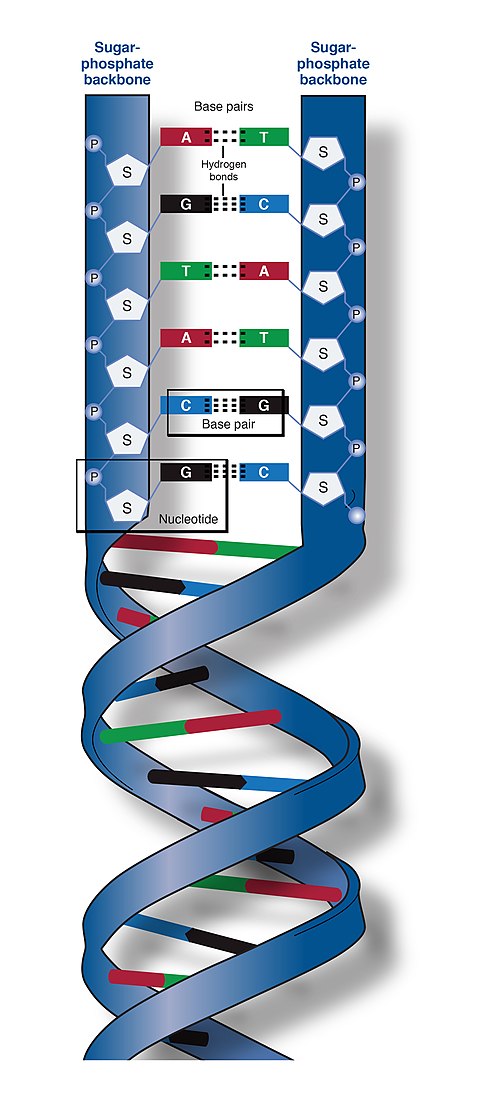
Simplified diagram

Impure DNA extracted from an orange

A current model of meiotic recombination, initiated by a double-strand break or gap, followed by pairing with an homologous chromosome and strand invasion to initiate the recombinational repair process. Repair of the gap can lead to crossover (CO) or non-crossover (NCO) of the flanking regions. CO recombination is thought to occur by the Double Holliday Junction (DHJ) model, illustrated on the right, above. NCO recombinants are thought to occur primarily by the Synthesis Dependent Strand Annealing (SDSA) model, illustrated on the left, above. Most recombination events appear to be the SDSA type.

Maclyn McCarty (left) shakes hands with Francis Crick and James Watson, co-originators of the double-helix model based on the X-ray diffraction data and insights of Rosalind Franklin and Raymond Gosling.