George Grosz
Videos
George Grosz was a German artist known especially for his caricatural drawings and paintings of Berlin life in the 1920s. He was a prominent member of the Berlin Dada and New Objectivity groups during
George Grosz in 1921


Daum Marries Her Pedantic Automaton "George" in May 1920, mixed media on canvas, Berlinische Galerie

Grosz's tomb in the Friedhof Heerstraße, Berlin

Café, 1915, Hirshhorn Museum
Dada
Videos
Dada or Dadaism was an international art movement that developed in the context of World War I, its aftermath, and the Futurist movement. First established in Zürich, Switzerland, it later quickly spr
George Grosz
…was a German artist known especially for his caricatural drawings and paintings of Berlin life in the 1920s. He was a prominent member of the Berlin Dada and New Objectivity groups during the Weimar Republic. He emigrated to the United States in 1933, and became a naturalized citizen in 1938. Abandoning…

Grand opening of the first Dada exhibition: International Dada Fair, Berlin, 5 June 1920. The central figure hanging from the ceiling is an effigy of a German officer with a pig's head. From left to right: Raoul Hausmann, Hannah Höch (sitting), Otto Burchard, Johannes Baader, Wieland Herzfelde, Margarete Herzfelde, Dr. Oz (Otto Schmalhausen), George Grosz and John Heartfield.

Cover of the first edition of the publication Dada, Tristan Tzara; Zürich, 1917

Francis Picabia: left, Le saint des saints c'est de moi qu'il s'agit dans ce portrait, 1 July 1915; center, Portrait d'une jeune fille americaine dans l'état de nudité, 5 July 1915; right, J'ai vu et c'est de toi qu'il s'agit, De Zayas! De Zayas! Je suis venu sur les rivages du Pont-Euxin, New York, 1915[clarification needed]
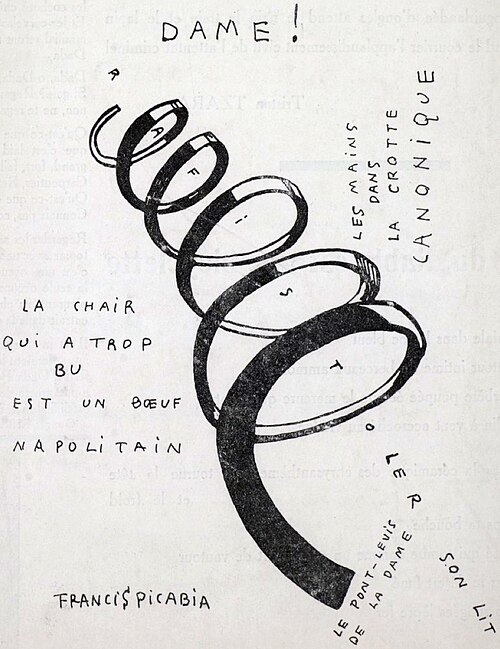
Francis Picabia, Dame! Illustration for the cover of the periodical Dadaphone, n. 7, Paris, March 1920