George Stephenson
Videos
George Stephenson was an English civil engineer and mechanical engineer during the Industrial Revolution. Renowned as the "Father of Railways", Stephenson was considered by the Victorians as a great example of diligent application and thirst for improvement. His chosen rail gauge, sometimes called "Stephenson gauge", was the basis for the 4-foot-8+1⁄2-inch (1.435 m) standard gauge used by most of the world's railways.


Dial Cottage, West Moor, Killingworth. The sun-dial made and installed by George Stephenson is above the front door.
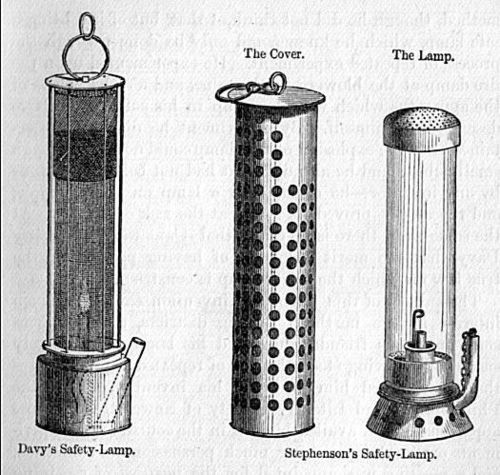
Stephenson's safety lamp shown with Davy's lamp on the left

Early Stephenson locomotive in Samuel Smiles' Lives of the Engineers (1862). Called an 1816 Killingworth Colliery locomotive (often claimed to be Blücher), it looks more like the slightly later Hetton colliery railway locomotives whose 1852 replica Lyons was still operating in Smiles' time.
The Liverpool and Manchester Railway (L&MR) was the first inter-city railway in the world. It opened on 15 September 1830 between the Lancashire towns of Liverpool and Manchester in England. It was also the first railway to rely exclusively on locomotives driven by steam power, with no horse-drawn traffic permitted at any time; the first to be entirely double track throughout its length; the first to have a true signalling system; the first to be fully timetabled; and the first to carry mail.

A lithograph of the Liverpool and Manchester Railway crossing the Bridgewater Canal at Patricroft, by A. B. Clayton.

Illustration of the railway in 1830

A replica LMR coach and Rocket at the Rocket 150 event

Stephenson's viaduct crosses the Sankey Brook, and the remains of the Sankey Canal. The viaduct is in use to this day.