George Wythe was an American academic, scholar and judge who was one of the Founding Fathers of the United States. The first of the seven signatories of the United States Declaration of Independence from Virginia, Wythe served as one of Virginia's representatives to the Continental Congress and the Philadelphia Convention and served on a committee that established the convention's rules and procedures. He left the convention before signing the United States Constitution to tend to his dying wife. He was elected to the Virginia Ratifying Convention and helped ensure that his home state ratified the Constitution. Wythe taught and was a mentor to Thomas Jefferson, John Marshall, Henry Clay and other men who became American leaders.
George Wythe
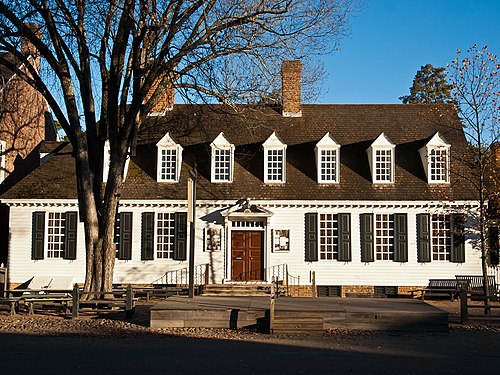
The George Wythe House in Colonial Williamsburg, Williamsburg, Virginia
In John Trumbull's Declaration of Independence, Wythe is in profile farthest to the viewer's left. Trumbull's 1818 painting was used for the back of the U.S. $2 bill, but Wythe's image was cut out of that depiction.
George Wythe gravestone at St. John's Episcopal Church in Richmond, Virginia
Signing of the United States Declaration of Independence
The signing of the United States Declaration of Independence occurred primarily on August 2, 1776, at the Pennsylvania State House in Philadelphia, later to become known as Independence Hall. The 56 delegates to the Second Continental Congress represented the 13 colonies, 12 of which voted to approve the Declaration of Independence on July 4, 1776. The New York delegation abstained because they had not yet received instructions from Albany to vote for independence. The Declaration proclaimed the signatory colonies were now "free and independent States", no longer colonies of the Kingdom of Great Britain and, thus, no longer a part of the British Empire. The signers’ names are grouped by state, with the exception of John Hancock, as President of the Continental Congress; the states are arranged geographically from south to north, with Button Gwinnett from Georgia first, and Matthew Thornton from New Hampshire last.
John Trumbull's 1819 painting, Declaration of Independence, depicts the five-man drafting committee of the Declaration of Independence presenting their work to the Second Continental Congress
The 56 signatures on the Declaration of Independence
The Syng inkstand was used during the 1776 signing of the Declaration and the 1787 signing of the U.S. Constitution
The U.S. Post Office in 1869 issued for the first time a stamp commemorating the signing of the Declaration of Independence.