Georgia–Russia relations
Videos
Photos
Russia and Georgia have had relations for centuries. The contacts between the two date back to the 15th and 16th centuries, and the most important stage started in the 1580s, when the Georgian kingdom of Kakheti and the Russian Empire signed a treaty of alliance in 1587. Since then, Georgia–Russia relations have been developing vibrantly and culminated in the Treaty of Georgievsk, which established eastern Georgia as a protectorate of Russia. At that time, Georgia saw Russia as a powerful Christian and modernizing neighbor, capable of protecting Georgia from invading Muslim empires and North Caucasian raiders.

Russian ambassadors at the court of the King of Imereti (1651), by Teramo Castelli.

The 11th Red Army of the Russian SFSR occupies Tbilisi, February 25, 1921.

Vladimir Putin with Eduard Shevardnadze in 2002.

Vladimir Putin with Mikheil Saakashvili in 2006
Georgia (country)
Videos
Photos
Georgia is a transcontinental country in Eastern Europe and West Asia. It is part of the Caucasus region, bounded by the Black Sea to the west, Russia to the north and northeast, Turkey to the southwest, Armenia to the south, and Azerbaijan to the southeast. Georgia covers an area of 69,700 square kilometres (26,900 sq mi). It has a population of 3.7 million, of which over a third live in the capital and largest city, Tbilisi. Georgians, who are indigenous to the region, constitute a majority and a titular nation in Georgia.

King Mirian III converted the nation to Christianity in the 4th century.

Northwestern Georgia is home to the medieval defensive Svan towers of Ushguli and Mestia.

Bedia Chalice, a medieval Georgian goldsmithery dated c. 999 AD.
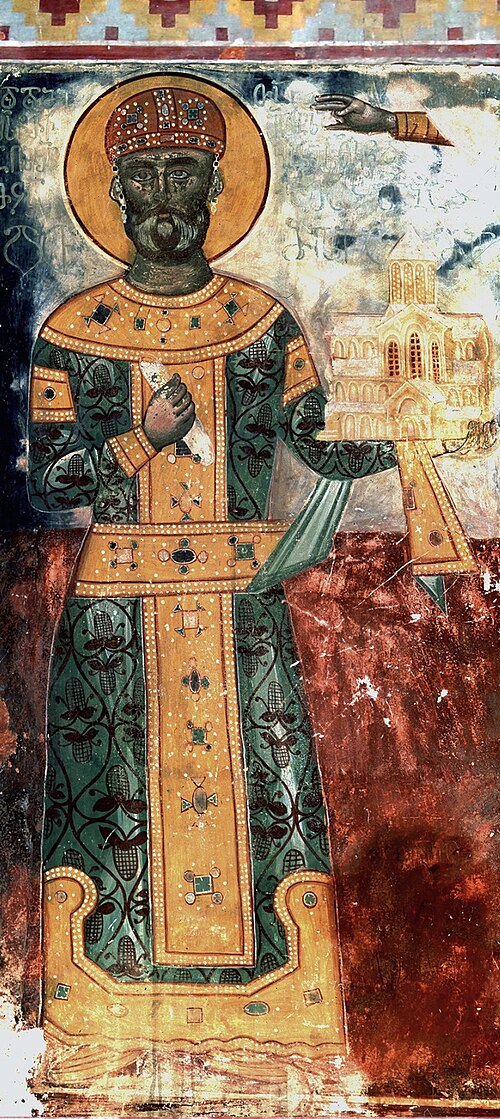
David the Builder, the original architect of the Golden Age. Fresco from Gelati monastery.