German Confederation
Videos
The German Confederation was an association of 39 predominantly German-speaking sovereign states in Central Europe. It was created by the Congress of Vienna in 1815 to replace the Holy Roman Empire, w
Frontispiece of the Acts of the Congress of Vienna

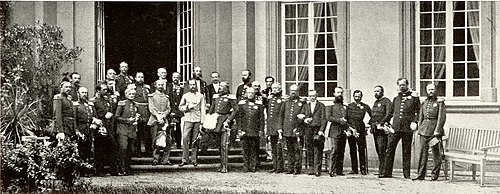
Monarchs of the member states of the German Confederation (with the exception of the Prussian king) meeting at Frankfurt in 1863

Austrian chancellor and foreign minister Klemens von Metternich dominated the German Confederation from 1815 until 1848.

The University of Berlin in 1850
Holy Roman Empire
Videos
The Holy Roman Empire, also known as the Holy Roman Empire of the German Nation after 1512, was a polity comprised of and controlling much of Central Europe and Western Europe, headed by the Holy Roma
German Confederation
…an association of 39 predominantly German-speaking sovereign states in Central Europe. It was created by the Congress of Vienna in 1815 to replace the Holy Roman Empire, which dissolved in 1806 as a result of the Napoleonic Wars. The Confederation had only one organ, the Bundesversammlung, or Federal Convention (also…

The Holy Roman Empire during the Ottonian dynasty

Henry begging Matilda of Tuscany and Hugh of Cluny in Canossa Castle (miniature in an illuminated manuscript kept in the Vatican Library, 1115)

Frederick Barbarossa, Holy Roman Emperor

Frederick II, Holy Roman Emperor