Germania is the name of a painting that was probably created in March 1848. It hung in the St. Paul's Church in Frankfurt, Germany. At that time, first the so-called Pre-Parliament and then the Frankf
Germania, painted in 1848


Frankfurt Parliament meeting in the Paulskirche decorated with the painting in 1848–49 (coloured, contemporary engraving). The yellow color on the flag is of contemporary imagination.
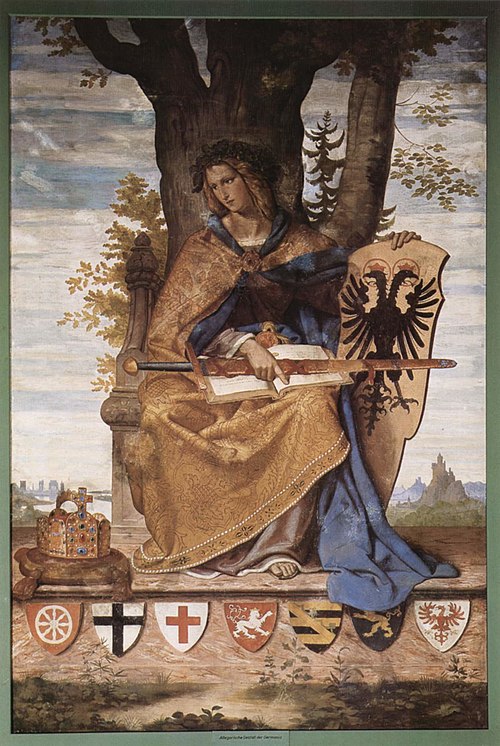
''Germania'' by Philipp Veit, 1836

The original, present-day exhibition in Nuremberg
Germania (personification)
Videos
Germania is the personification of the German nation or the German people as a whole. Like many other national personification symbols, she appeared first during the Roman Era. During the Medieval era
Germania (St. Paul's Church, Frankfurt am Main)
…the painting was taken down. In 1867 it was moved to the German National Museum in Nuremberg. The painting is one of the best-known representations of Germania, a woman who stands for Germany. Such a national allegory also exists in other countries. The motif was often taken up during the time of the emerging…

Figure of Germania atop the Niederwalddenkmal in the Rhine valley, dedicated 1883

Germania sitting on a shield, with a broken spear, Domitian's aureus, 89

Germania in the guise of Minerva, denarius of Hadrian, 134