Germania (personification)
Videos
Germania is the personification of the German nation or the German people as a whole. Like many other national personification symbols, she appeared first during the Roman Era. During the Medieval era
Germania painting from 1848, by Philipp Veit. This image once covered the old organ inside the Paulskirche, above where the Frankfurt Parliament assembled from 1848 to 1849.


Figure of Germania atop the Niederwalddenkmal in the Rhine valley, dedicated 1883

Germania sitting on a shield, with a broken spear, Domitian's aureus, 89

Germania in the guise of Minerva, denarius of Hadrian, 134
National personification
Videos
A national personification is an anthropomorphic personification of a state or the people it inhabits. It may appear in political cartoons and propaganda. In the first personifications in the Western
Germania (personification)
…Germania (; Latin: ) is the personification of the German nation or the German people as a whole. Like many other national personification symbols, she appeared first during the Roman Era. During…

The allegorical personification of Italy (Italia turrita; lit. 'Turreted Italy'), goes back to ancient Rome. The woman is linked to Cybele, an Anatolian fertility goddess.

Saint Michael at right, gesturing to, from left: an unspecified figure, Britannia, Italia, Austria, Mother Russia, Germania, and Marianne of France
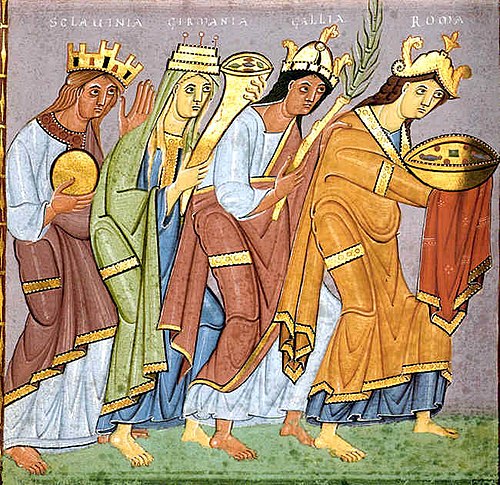
An early example of national personification in the Gospels of Otto III dated 990: Sclavinia, Germania, Gallia, and Roma, bringing offerings to Emperor Otto III.

Britannia arm-in-arm with Uncle Sam symbolizes the British-American alliance in World War I. The two animals, the Bald eagle and the Barbary lion, are also national personifications of the two countries.