Giants (Greek mythology)
Videos
In Greek and Roman mythology, the Giants, also called Gigantes, were a race of great strength and aggression, though not necessarily of great size, known for the Gigantomachy, their battle with the Ol
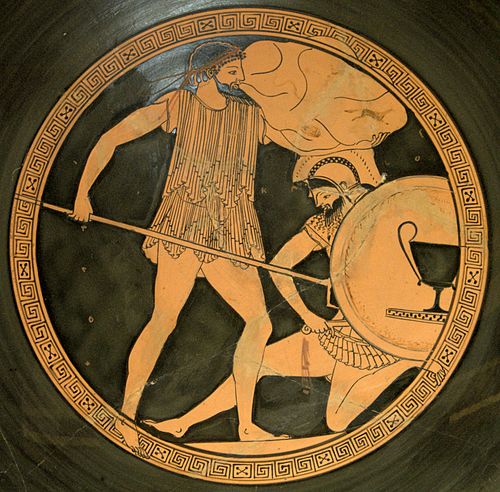
Poseidon (left) holding a trident, with the island Nisyros on his shoulder, battling a Giant (probably Polybotes), red-figure cup c. 500–450 BC (Cabinet des Médailles 573)

Athena (left) fighting the Giant Enceladus (inscribed retrograde) on an Attic red-figure dish, c. 550–500 BC (Louvre CA3662).

Dionysus (left) with ivy crown, and thyrsus attacking a Giant, Attic red-figure pelike, c. 475–425 BC (Louvre G434).

Ancient Roman mosaic with Poseidon fighting Polybotes, exhibited in Rhodes.
Titanomachy
Videos
In Greek mythology, the Titanomachy was a ten-year war fought in ancient Thessaly, consisting of most of the Titans fighting against the Olympians and their allies. The war was fought to decide which
Giants (Greek mythology)
…conflated the Giants and their Gigantomachy with an earlier set of offspring of Gaia and Uranus, the Titans and their war with the Olympian gods, the Titanomachy. This confusion extended to other opponents of the Olympians, including the huge monster Typhon, the offspring of Gaia and Tartarus, whom Zeus finally…
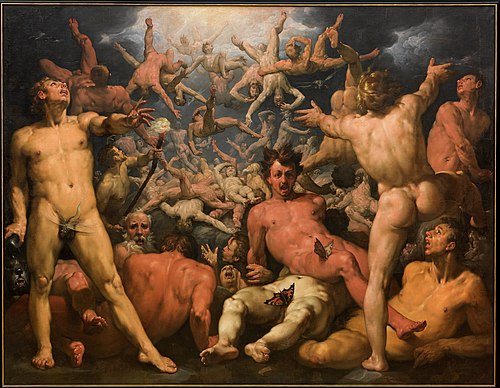
Cornelis Cornelisz van Haarlem, The Fall of the Titans, 1596–1598.

Rhea giving the rock to Cronus, 19th-century painted frieze by Karl Friedrich Schinkel.

Joachim Wtewael, The Battle Between the Gods and the Titans, oil on copper, 1600
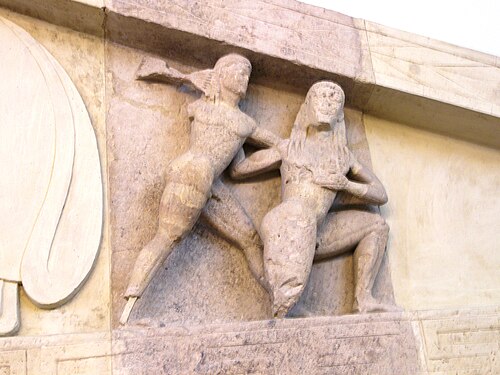
A possible Titanomachy: A beardless Zeus is depicted launching a thunderbolt against a kneeling figure (a Titan?) at the Gorgon pediment from the Temple of Artemis in Corfu as exhibited at the Archaeological Museum of Corfu.