Giovanni Battista Riccioli
Videos
Giovanni Battista Riccioli was an Italian astronomer and a Catholic priest in the Jesuit order. He is known, among other things, for his experiments with pendulums and with falling bodies, for his dis
Giovanni Battista Riccioli
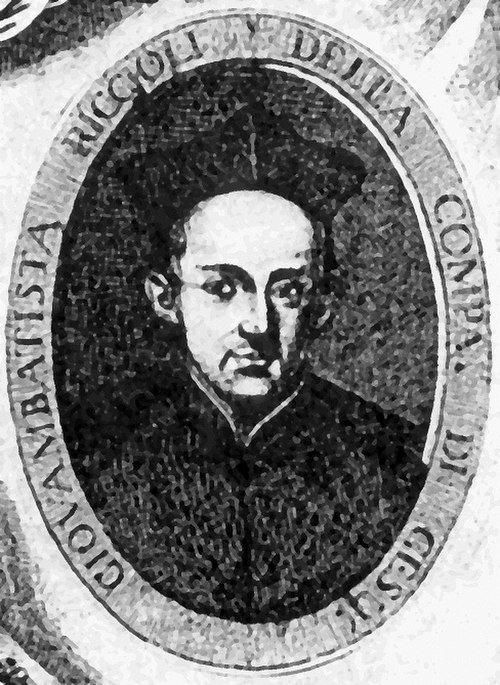

Riccioli as portrayed in the 1742 Atlas Coelestis (plate 3) of Johann Gabriel Doppelmayer.

The crescent phases of Venus and detailed representations of its appearance as seen through a telescope, from Riccioli's 1651 New Almagest.

Frontispiece of Riccioli's 1651 New Almagest. Mythological figures observe the heavens with a telescope and weigh the heliocentric theory of Copernicus in a balance against his modified version of Tycho Brahe's geo-heliocentric system, in which the Sun, Moon, Jupiter, and Saturn orbit the Earth while Mercury, Venus, and Mars orbit the Sun. The old Ptolemaic geocentric theory lies discarded on the ground, made obsolete by the telescope's discoveries. These are illustrated at top and include phases of Venus and Mercury and a surface feature on Mars (left), moons of Jupiter, rings of Saturn, and features on the Moon (right). The balance tips in favor of Riccioli's "Tychonic" system.
Coriolis force
Videos
In physics, the Coriolis force is a pseudo-force that acts on objects in motion within a frame of reference that rotates with respect to an inertial frame. In a reference frame with clockwise rotation
Giovanni Battista Riccioli
…called the "physico-mathematical argument", which was related to one of Galileo's conjectures; second, an argument based on what today is known as the "Coriolis effect"; third, an argument based on the appearance of stars as seen through the telescopes of the time. Riccioli discusses the physico-mathematical argument…

Image from Cursus seu Mundus Mathematicus (1674) of C.F.M. Dechales, showing how a cannonball should deflect to the right of its target on a rotating Earth, because the rightward motion of the ball is faster than that of the tower.

Image from Cursus seu Mundus Mathematicus (1674) of C.F.M. Dechales, showing how a ball should fall from a tower on a rotating Earth. The ball is released from F. The top of the tower moves faster than its base, so while the ball falls, the base of the tower moves to I, but the ball, which has the eastward speed of the tower's top, outruns the tower's base and lands further to the east at L.

Due to the Coriolis force, low-pressure systems in the Northern Hemisphere, like Typhoon Nanmadol (left), rotate counterclockwise, and in the Southern Hemisphere, low-pressure systems like Cyclone Darian (right) rotate clockwise.

Cloud formations in a famous image of Earth from Apollo 17, makes similar circulation directly visible