Golden Bull of 1356
Videos
The Golden Bull of 1356 was a decree issued by the Imperial Diet at Nuremberg and Metz headed by the Emperor Charles IV which fixed, for a period of more than four hundred years, important aspects of

The golden seal that earned the decree its name

Page from the Golden Bull manuscript of King Wenceslaus, about 1400, Austrian National Library

Imperial Diet in Metz during which the Golden Bull of 1356 was issued

Incunable of the Golden Bull in Early New High German, late 15th century, University of Jena
Prince-elector
Videos
A Prince-Elector of the Holy Roman Empire was a member of the Electoral College of the Holy Roman Empire, which elected the Holy Roman Emperor, initially according to formally unregulated customs, and
Golden Bull of 1356
…clarify the process in the Declaration of Rhense of 1338, which renounced any papal involvement and had restricted the right to choose a new king to the prince-electors. The Golden Bull, promulgated by Louis's successor and rival, Charles IV, was more precise in several ways. Firstly, the Bull explicitly named the seven…
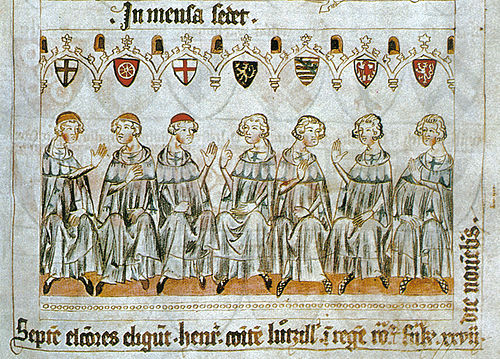
The imperial prince-electors Left to right: Archbishop of Cologne, Archbishop of Mainz, Archbishop of Trier, Count Palatine, Duke of Saxony, Margrave of Brandenburg and King of Bohemia (Codex Balduini Trevirorum, c. 1340)
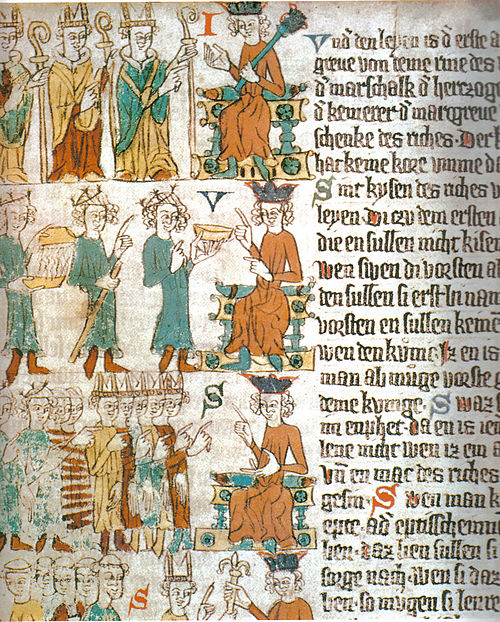
Choosing the king. Above: the three ecclesiastical princes choosing the king, pointing at him. Middle: the Count Palatine of the Rhine hands over a golden bowl, acting as a servant. Behind him, the Duke of Saxony with his marshal's staff and the Margrave of Brandenburg bringing a bowl of warm water, as a valet. Below, the new king in front of the great men of the empire (Heidelberg Sachsenspiegel, around 1300).
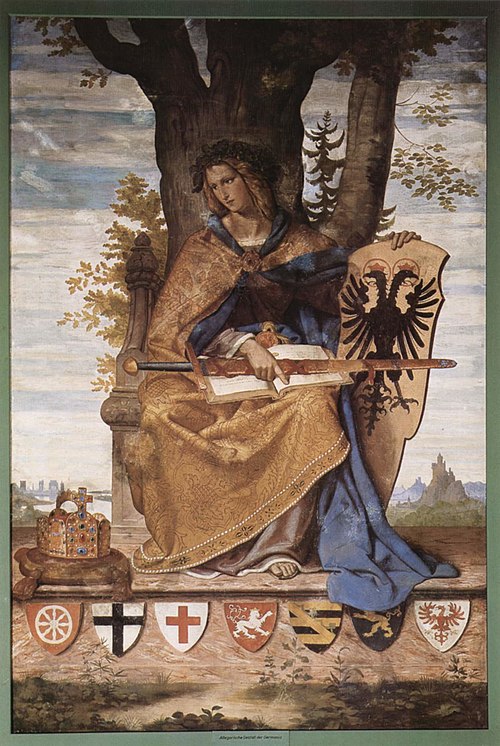
Coats of arms representing the seven original electors with the figure of Germania. Original colours were vivid. Germania's gown was gold, not beige, and the blue-grey was purple. Also, the browns were painted as vivid red and the muted grey in Saxony's arms was a brilliant green.
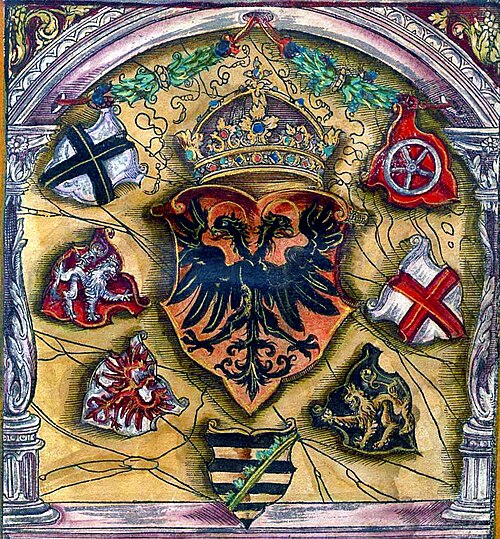
Coats of arms of prince electors surround the Holy Roman Emperor's; from flags book of Jacob Köbel (163#+1545). Left to right: Cologne, Bohemia, Brandenburg, Saxony, the Palatinate, Trier, Mainz.