The Imperial Diet was the deliberative body of the Holy Roman Empire. It was not a legislative body in the contemporary sense; its members envisioned it more like a central forum where it was more imp
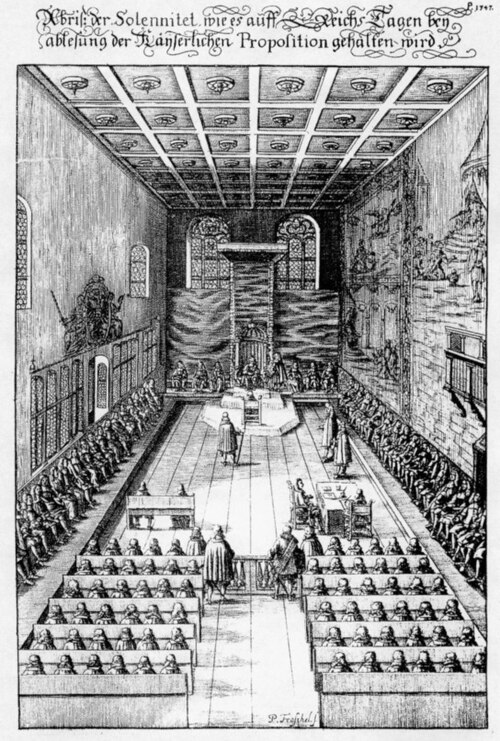
Seating plan for an inauguration of the Imperial Diet in the Regensburg Town Hall from a 1675 engraving: Emperor and prince-electors at the head, secular princes to the left, ecclesiastical to the right, deputies of imperial cities in the foreground.

The summons for Luther to appear at the Diet of Worms, signed by Charles V. The text on the left was on the reverse side.

"Here I stand": Martin Luther at the Diet of Worms, 1521 19th-century painting by Hermann Wislicenus

A view of Regensburg, c. 1600
Holy Roman Empire
Videos
The Holy Roman Empire, also known as the Holy Roman Empire of the German Nation after 1512, was a polity comprised of and controlling much of Central Europe and Western Europe, headed by the Holy Roma
Imperial Diet (Holy Roman Empire)
…The Imperial Diet (German: Reichstag; Latin: Dieta Imperii or Comitium Imperiale) was the deliberative body of the Holy Roman Empire. It was not a legislative body in the contemporary sense; its members envisioned it more like a central forum where it was more important to negotiate…

The Holy Roman Empire during the Ottonian dynasty

Henry begging Matilda of Tuscany and Hugh of Cluny in Canossa Castle (miniature in an illuminated manuscript kept in the Vatican Library, 1115)

Frederick Barbarossa, Holy Roman Emperor

Frederick II, Holy Roman Emperor