Holy Roman Empire
Videos
The Holy Roman Empire, also known as the Holy Roman Empire of the German Nation after 1512, was a polity comprised of and controlling much of Central Europe and Western Europe, headed by the Holy Roma

The Holy Roman Empire during the Ottonian dynasty

Henry begging Matilda of Tuscany and Hugh of Cluny in Canossa Castle (miniature in an illuminated manuscript kept in the Vatican Library, 1115)

Frederick Barbarossa, Holy Roman Emperor

Frederick II, Holy Roman Emperor
Holy Roman Emperor
Videos
The Holy Roman Emperor, originally and officially the Emperor of the Romans during the Middle Ages, and also known as the Roman-German Emperor since the early modern period, was the ruler and head of
Holy Roman Empire
…Holy Roman Empire of the German Nation after 1512, was a polity comprised of and controlling much of Central Europe and Western Europe, headed by the Holy Roman Emperor and characterized by a decentralized political structure. It developed in the Early Middle Ages (beginning in either 800 or 962), and lasted for a…
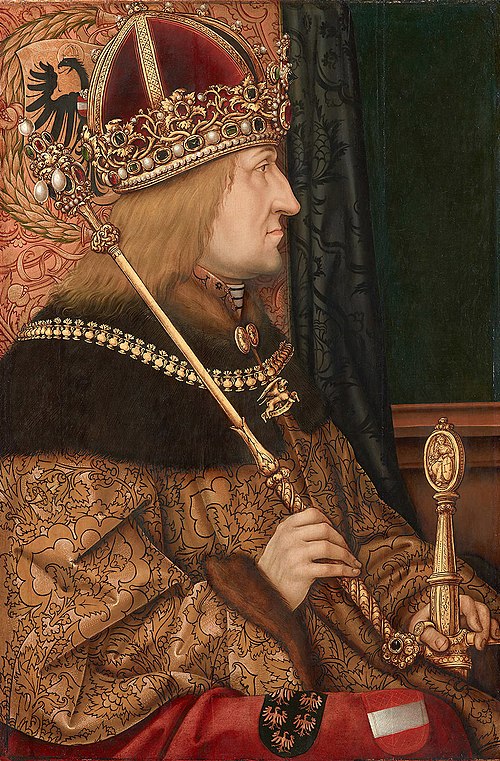
Longest reigning Frederick III 19 March 1452 – 19 August 1493
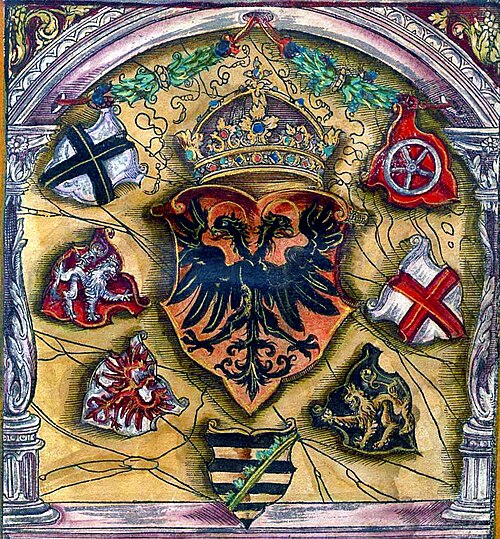
Coats of arms of prince electors surround the imperial coat of arms; from a 1545 armorial. Electors voted in an Imperial Diet for a new Holy Roman Emperor.

Depiction of Charlemagne in a 12th-century stained glass window, Strasbourg Cathedral, now at Musée de l'Œuvre Notre-Dame.
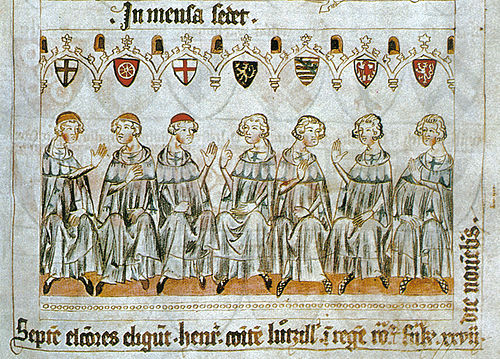
Illustration of the election of Henry VII (27 November 1308) showing (left to right) the Archbishop of Cologne, Archbishop of Mainz, Archbishop of Trier, Count Palatine of the Rhine, Duke of Saxony, Margrave of Brandenburg and King of Bohemia (Codex Balduini Trevirorum, c. 1340).