A golden age is a period considered the peak in the history of a country or people, a time period when the greatest achievements were made. The term originated from early Greek and Roman poets, who used it to refer to a time when mankind lived in a better time and was pure.
The Golden Age by Lucas Cranach the Elder, 1530
The Golden Age by Joachim Wtewael, 1605
Acropolis, rebuilt by Pericles during the Athenian Golden Age
The Macedonian era is often cited as the Golden Age of Byzantium
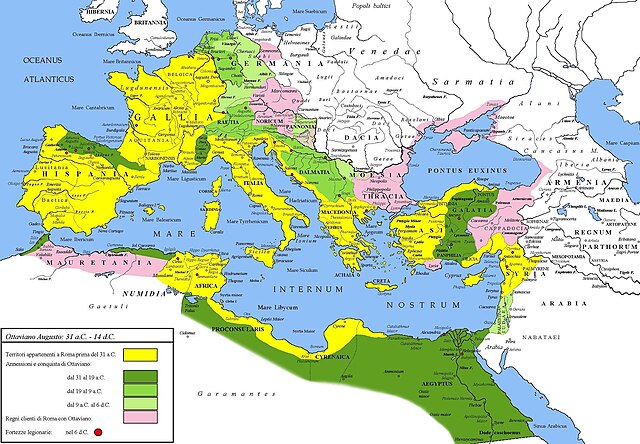
The Pax Romana is a roughly 200-year-long period of Roman history which is identified as a golden age of increased and sustained Roman imperialism, relative peace and order, prosperous stability, hegemonic power, and regional expansion. This is despite several revolts and wars, and continuing competition with Parthia. It is traditionally dated as commencing with the accession of Augustus, founder of the Roman principate, in 27 BC and concluding in AD 180 with the death of Marcus Aurelius, the last of the "Five Good Emperors".
Extent of the Roman Empire under Augustus. Yellow represents the extent of the Republic in 31 BC, while green represents gradually conquered territories under the reign of Augustus, and pink areas represent client states.
AR Antoninianus of Gordian III, struck at Antioch 243–244 AD with Pax Augusta on the reverse