Gravitational wave
Videos
Gravitational waves are waves of spacetime curvature produced by the relative motion of gravitating masses and which propagate away at the speed of light. They were first predicted by Albert Einstein

The gravitational wave spectrum with sources and detectors. Credit: NASA Goddard Space Flight Center

Artist's impression of merging neutron stars, a source of gravitational waves

Now disproved evidence allegedly showing gravitational waves in the infant universe was found by the BICEP2 radio telescope. The microscopic examination of the focal plane of the BICEP2 detector is shown here. In January 2015, however, the BICEP2 findings were confirmed to be the result of cosmic dust.
Radiant energy
Videos
In physics, and in particular as measured by radiometry, radiant energy is the energy of electromagnetic and gravitational radiation. As energy, its SI unit is the joule. The quantity of radiant energ
Gravitational wave
…observations and, since 2015, directly through dedicated observatories. Gravitational waves transport energy as gravitational radiation, a form of radiant energy similar to electromagnetic radiation. Newton's law of universal gravitation, part of classical mechanics, does not provide for their existence, instead…

Visible light such as sunlight carries radiant energy, which is used in solar power generation.
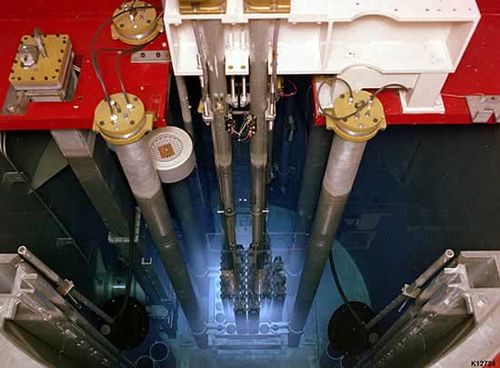
Cherenkov radiation glowing in the core of a TRIGA reactor.