The Great Ordovician Biodiversification Event was an evolutionary radiation of marine animal life throughout the Ordovician period, 40 million years after the Cambrian explosion, whereby the distincti

Possible line of meteors (on the modern globe) associated with the Middle Ordovician meteor event 467.5±0.28 million years ago. Although this is suggestive of a single large meteorite shower, the exact alignment of continental plates 470 million years ago is unknown and the exact timing of meteors is also unknown.

Atrypid brachiopods (Zygospira modesta) preserved in their original positions on a trepostome bryozoan; Cincinnatian (Upper Ordovician) of southeastern Indiana.
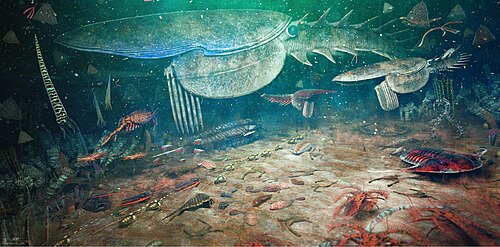
Reconstruction of the Fezouata Biota, featuring roughly 50 different species. The largest animal, Aegirocassis benmoulai (just over 2 metres — 6.6 feet — in length), is depicted in a pair swimming just above the seafloor. This giant radiodont is one of the earliest "giant" filter feeders, with frontal appendages bearing baleen-like spines. These adaptations were likely influenced by the proliferation of plankton in the early Ordovician.
Ordovician
Videos
The Ordovician is a geologic period and system, the second of six periods of the Paleozoic Era, and the second of twelve periods of the Phanerozoic Eon. The Ordovician spans 43.75 million years from t
Great Ordovician Biodiversification Event
…The Great Ordovician Biodiversification Event (GOBE) was an evolutionary radiation of marine animal life throughout the Ordovician period, 40 million years after the Cambrian explosion, whereby the distinctive Cambrian fauna fizzled out to be replaced with a Paleozoic fauna rich…

External mold of the Ordovician bivalve Anomalodonta gigantea showing that the original aragonite shell dissolved on the sea floor, leaving a cemented mold for biological encrustation (Waynesville Formation of Franklin County, Indiana).

A diorama depicting Ordovician flora and fauna

Fossiliferous limestone slab from the Liberty Formation (Upper Ordovician) of Caesar Creek State Park near Waynesville, Ohio.

The trilobite Isotelus from Wisconsin