Green Knight
Videos
The Green Knight is a heroic character of the Matter of Britain, originating in the 14th-century poem Sir Gawain and the Green Knight and the related medieval work The Greene Knight. His true name is
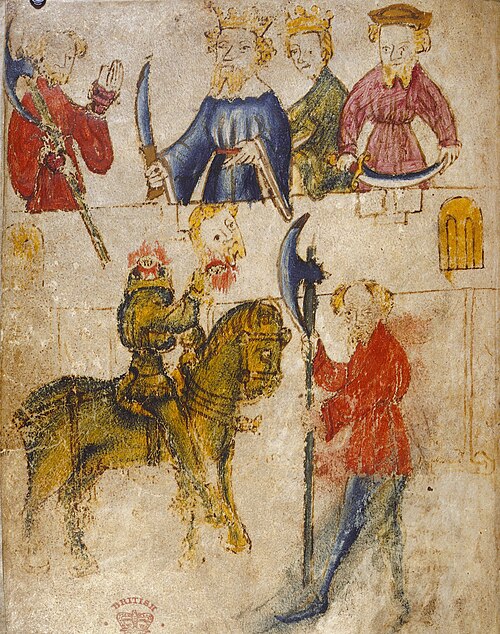
A painting from the original manuscript of Sir Gawain and the Green Knight. The Green Knight is seated on the horse, holding up his severed head in his right hand.
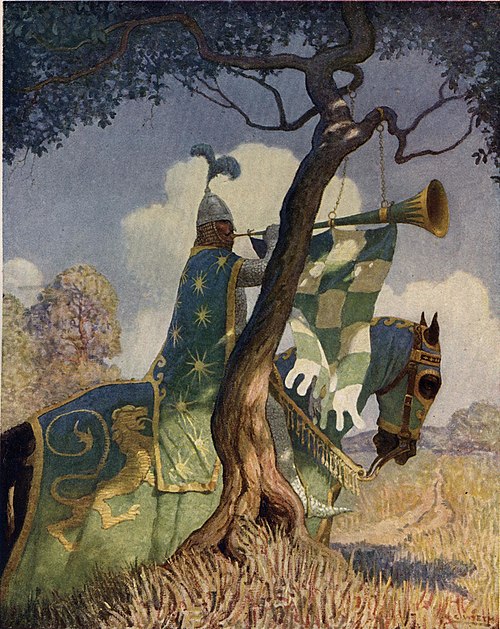
The Green Knight preparing to battle Sir Beaumains in N. C. Wyeth's illustration for Sidney Lanier's The Boy's King Arthur: Sir Thomas Malory's History of King Arthur and His Knights of the Round Table (1922)

Michael Pacher's painting of a green Devil with Saint Augustine in 1475. Poetic contemporaries such as Chaucer also made associations between the colour green and the devil, causing scholars to make similar associations in readings of the Green Knight.
The Green Knight (film)
Videos
The Green Knight is a 2021 dark fantasy adventure film directed, written, produced, and edited by David Lowery. It is an adaptation from the 14th-century poem Sir Gawain and the Green Knight and stars
Green Knight
…Iris Murdoch wrote a novel called The Green Knight. The film The Green Knight depicted the titular character (performed by Ralph Ineson) as a wood-skinned character. His history in King Arthur's court and being beheaded by Gawain…

Theatrical release poster

Plaque at Cahir Castle, Ireland, commemorating its use as a filming location for The Green Knight.

The Wonderful Barn, used for filming as the "crooked tower."

The mass closures of cinemas brought on by the COVID-19 pandemic forced the release of The Green Knight to be delayed from May 2020 to July 2021.