The Guggenheim Aeronautical Laboratory at the California Institute of Technology (GALCIT), was a research institute created in 1926, at first specializing in aeronautics research. In 1930, Hungarian scientist Theodore von Kármán accepted the directorship of the lab and emigrated to the United States. Under his leadership, work on rockets began there in 1936. GALCIT was the first—and from 1936 to 1940 the only—university-based rocket research center. Based on GALCIT's JATO project at the time, the Jet Propulsion Laboratory was established under a contract with the United States Army in November 1943.

The Guggenheim Aeronautical Laboratory building at Caltech in 2017

A plaque at the Jet Propulsion Laboratory commemorating the first GALCIT liquid propellant rocket engine test firing.

Take-off on August 12, 1941 of America's first "rocket-assisted" fixed-wing aircraft, an Ercoupe fitted with a GALCIT developed solid propellant JATO booster.
Edward Forman
Videos
Edward Seymour Forman was an American engineer and inventor known for his pioneering work in early rocketry in the United States. Forman, along with his collaborators in Guggenheim Aeronautical Laboratory at the California Institute of Technology (GALCIT), demonstrated the first practical jet-assisted take-off (JATO) of an aircraft in the United States. Forman was among the GALCIT innovators that went on to found Aerojet General Corporation, the largest rocket technology manufacturer in the 1940s, and the GALCIT Rocket Research Group itself became the precursor of the Jet Propulsion Laboratory.

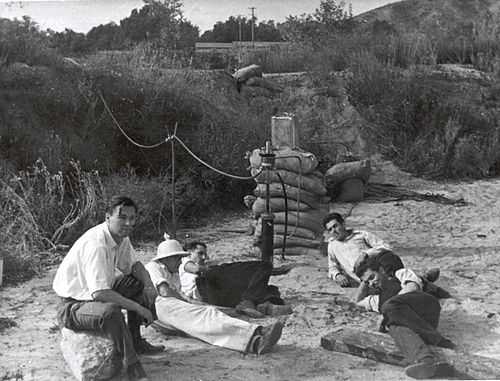
GALCIT members in the Arroyo Seco, November 1936. Left foreground to right: Rudolph Schott, Amo Smith, Frank Malina, Ed Forman, and Jack Parsons. This photo is known in the JPL community as the Nativity Scene.

Image: JATO unit