Gutians
Videos
The Guti, also known by the derived exonyms Gutians or Guteans, were a people of the ancient Near East who both appeared and disappeared during the Bronze Age. Their homeland was known as Gutium. Conf

Tablet of Lugalanatum

"Gutium"

The Gutians capturing a Babylonian city, as Akkadians are making a stand outside their city. Illustration published 1915.

King Anubanini of Lullubi, holding an axe and a bow, trampling a foe. Anubanini rock relief, circa 2300-2000 BC. Sar-I Pul, Iran. The Gutians "were close neighbours, hardly to be distinguished" from the Lullubi.
Akkadian Empire
Videos
The Akkadian Empire or the Kingdom of Akkad/Agade was an ancient kingdom established around 2334 BCE, and the first empire in world history, succeeding the long-lived city-states of Sumer. Centered on
Gutians
…during the Bronze Age. Their homeland was known as Gutium (Sumerian: 𒄖𒌅𒌝𒆠, GutūmKI or 𒄖𒋾𒌝𒆠, GutiumKI). Conflict between people from Gutium and the Akkadian Empire has been linked to the collapse of the empire, towards the end of the 3rd millennium BCE, although economic factors, climate change and internal strife…

Bronze head of an Akkadian ruler, discovered in Nineveh in 1931, presumably depicting either Sargon or, more probably, Sargon's grandson Naram-Sin.

Sargon on his victory stele, with a royal hair bun, holding a mace and wearing a flounced royal coat on his left shoulder with a large belt (left), followed by an attendant holding a royal umbrella. The name of Sargon in cuneiform ("King Sargon") appears faintly in front of his face. Louvre Museum.
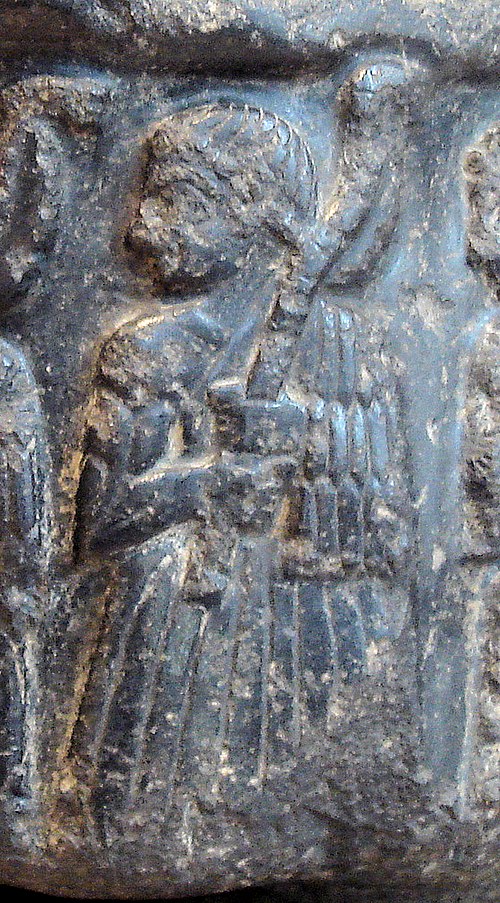
Akkadian official in the retinue of Sargon of Akkad, holding an axe

Prisoners escorted by a soldier, on a victory stele of Sargon of Akkad, circa 2300 BC. The hairstyle of the prisoners (curly hair on top and short hair on the sides) is characteristic of Sumerians, as also seen on the Standard of Ur. Louvre Museum.