Hamat Gader
Videos
Hamat Gader is a hot springs site in the Yarmuk River valley, located in an area under Israeli control, near the Golan Heights and the border with Jordan. It contains a spa, modern and ancient baths,

Modern hot springs-fed pools

Young Nile Crocodiles at Hamat Gader's Crocodilians Farm

Ancient Roman bath with arches
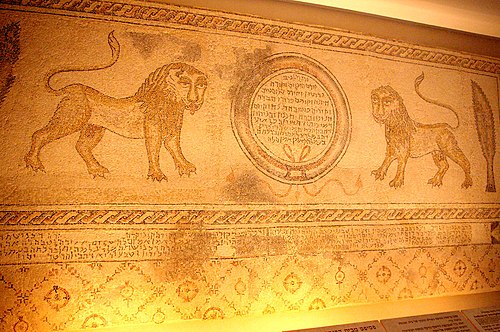
A section of the mosaic pavement recovered from the ancient Hamat Gader synagogue, now installed in the entrance hall of the Supreme Court of Israel.
Umayyad Caliphate
Videos
The Umayyad Caliphate or the Umayyad Empire was the second caliphate established after the death of the Islamic prophet Muhammad and was ruled by the Umayyad dynasty from 661 to 750. It succeeded the
Hamat Gader
…see it as they went into the pool. Some of the buildings including the famous thermae were damaged by an earthquake and restored in 663 by the first Umayyad caliph Mu'awiyah who ruled from Damascus. A century later the 749 Galilee earthquake hit. Eventually, in the 9th century, the baths were abandoned and…

Arab-Sasanian-style Umayyad coin minted under Mu'awiya I rule in Basra in 675/76 in the name of the Umayyad governor Ubayd Allah ibn Ziyad. The latter's governorship later spanned all of the eastern caliphate. His father Ziyad ibn Abihi was adopted as a half-brother by Mu'awiya I, who made him his practical viceroy over the eastern caliphate.

Abd al-Malik introduced an independent Islamic currency, the gold dinar, in 693, which originally depicted a human figure, likely the caliph, as shown in this coin minted in 695. In 697, the figural depictions were replaced solely by Qur'anic and other Islamic inscriptions

The Dome of the Rock, located within the Al-Aqsa Mosque compound in Jerusalem, is considered the oldest surviving major Islamic building.

The expansion of the Muslim Caliphate until 750, from William R. Shepherd's Historical Atlas. Muslim state at the death of Muhammad Expansion under the Rashidun Caliphate Expansion under the Umayyad Caliphate Byzantine Empire