Hecker uprising
Videos
The Hecker uprising was an attempt in April 1848 by Baden revolutionary leaders Friedrich Hecker, Gustav von Struve, and several other radical democrats to overthrow the Baden monarchy and establish a

Death of General Friedrich von Gagern in the Battle at Kandern, which ended the Hecker Uprising. The print shows the battle from the perspective of the Revolutionaries.

Franz Sigel, the leader of the Konstanz militia (pictured around 1861 as a Union officer in the US Civil War, following his emigration from Germany)

It was from this balcony on the Konstanz City Hall that Hecker supposedly declared the republic. The large maiolica reliefs were created by artist Johannes Grützke commemorating the Uprising.

Friedrich Hecker, depicted in an anti-Hecker, contemporary caricature outfitted in the "revolutionary uniform" of a saber, musket, and the "Hecker hat" which became associated with the revolutionaries.
The German revolutions of 1848–1849, the opening phase of which was also called the March Revolution, were initially part of the Revolutions of 1848 that broke out in many European countries. They wer
Hecker uprising
…monarchy and establish a republic in the Grand Duchy of Baden. The uprising was the first major clash in the Baden Revolution and among the first in the March Revolution in Germany, part of the broader Revolutions of 1848 across Europe. The main action of the uprising consisted of an armed civilian militia under the…
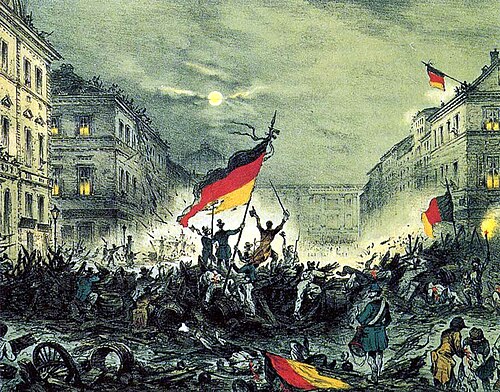
Origin of the Flag of Germany: Cheering revolutionaries in Berlin, Berlin Palace in the background, on 19 March 1848

The painting Germania, possibly by Philipp Veit, hung inside the Frankfurt parliament, the first national parliament in German history

Vienna Uprising, October 1848

The Battle of Kirchheimbolanden, 14 June 1849