Heliacal rising
Videos
The heliacal rising of a star or a planet occurs annually, when it becomes visible above the eastern horizon at dawn in the brief moment just before sunrise. A heliacal rising marks the time when a st

Sirius is the fixed star with the greatest apparent magnitude and one which is almost non-variable. The Pleiades, a key feature of Taurus shown across Orion in the same photograph also experience an annual period of visibility ("rising and setting"). Photo taken at sunset.
Sirius
Videos
Sirius is the brightest star in the night sky, located in the southern constellation of Canis Major. Its name is derived from the Greek word Σείριος. The star is designated α Canis Majoris, Latinized
Heliacal rising
…its heliacal setting), having since been in the sky only during daytime, obscured by sunlight. Historically, the most important such rising is that of Sirius, which was an important feature of the Egyptian calendar and astronomical development. The rising of the Pleiades heralded the start of the Ancient…

Hubble Space Telescope image of Sirius A and Sirius B. The white dwarf can be seen to the lower left. The diffraction spikes and concentric rings are instrumental effects. Sirius A is approximately one thousand times brighter than Sirius B.
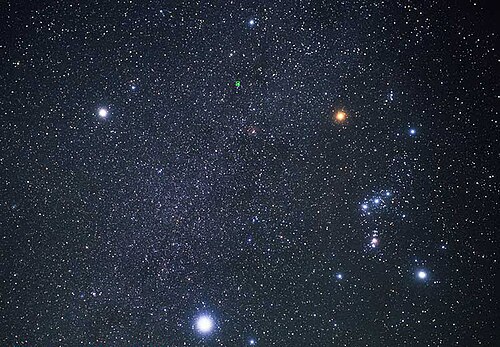
Sirius (bottom) and the constellation Orion (right). The three brightest stars in this image—Sirius, Betelgeuse (top right) and Procyon (top left)—form the Winter Triangle. The bright star at top center is Alhena, which forms a cross-shaped asterism with the Winter Triangle.

The constellations Canis Major (left) and Orion as seen with the naked eye. Sirius, left of centre, is the brightest star.

A Chandra X-ray Observatory image of the Sirius star system, where the spike-like pattern is due to the support structure for the transmission grating. The brighter source is Sirius B. Credit: NASA/SAO/CXC