Herto Man
Videos
Herto Man is a set of human remains discovered in 1997 from the Upper Herto member of the Bouri Formation in the Afar Triangle, Ethiopia. The remains have been dated as between 154,000 and 160,000 yea

Homo Sapiens Idaltu

Cast of the left side of BOU-VP-16/1 at the National Museum of Ethiopia

Stone tools from Herto (left), the Omo 2 skull (middle) and the juvenile BOU-VP-16/5 skull (right) at the National Museum of Ethiopia
Early modern human
Videos
Early modern human, or anatomically modern human, are terms used to distinguish Homo sapiens that are anatomically consistent with the range of phenotypes seen in contemporary humans, from extinct arc
Herto Man
…remains then described. In the original description paper, these 12 (at minimum) individuals were described as falling just outside the umbrella of "anatomically modern human". Thus, Herto Man was classified into a new subspecies as "Homo sapiens idaltu" (Afar: Idaltu "elder"). It supposedly represented a transitional morph…

Reconstruction of early Homo sapiens from Jebel Irhoud, Morocco, c. 315,000 years BP

100 to 80 thousand year old Skhul V from Israel

Layer sequence at Ksar Akil in the Levantine corridor, and discovery of two fossils of Homo sapiens, dated to 40,800 to 39,200 years BP for "Egbert", and 42,400–41,700 BP for "Ethelruda".
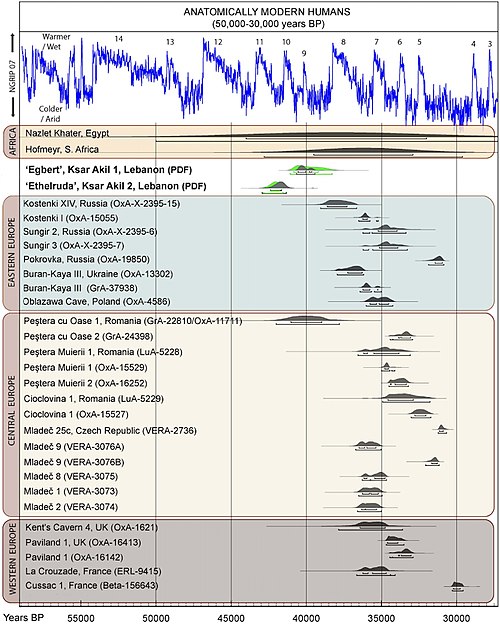
Known archaeological remains of anatomically modern humans in Europe and Africa, directly dated, calibrated carbon dates as of 2013.