High, Just-as-High, and Third
Videos
Photos
Hár, Jafnhár, and Þriði are three men on thrones who appear in the Prose Edda in the Gylfaginning, one of the oldest and most important sources on Norse mythology. Their names translate as High, Just-as-High, and Third in Old Norse, respectively. In the story, King Gylfi, calling himself Gangleri, engages in a test of wisdom with the three, asking them detailed questions about the Æsir, their deeds, and their future. The three respond until the final segment, in which the three men and the great hall suddenly disappear.

High, Just-As-High, and Third converse with Gangleri. Art from an 18th-century Icelandic manuscript.
Prose Edda
Videos
Photos
The Prose Edda, also known as the Younger Edda, Snorri's Edda or, historically, simply as Edda, is an Old Norse textbook written in Iceland during the early 13th century. The work is often considered to have been to some extent written, or at least compiled, by the Icelandic scholar, lawspeaker, and historian Snorri Sturluson c. 1220. It is considered the fullest and most detailed source for modern knowledge of Norse mythology, the body of myths of the North Germanic peoples, and draws from a wide variety of sources, including versions of poems that survive into today in a collection known as the Poetic Edda.
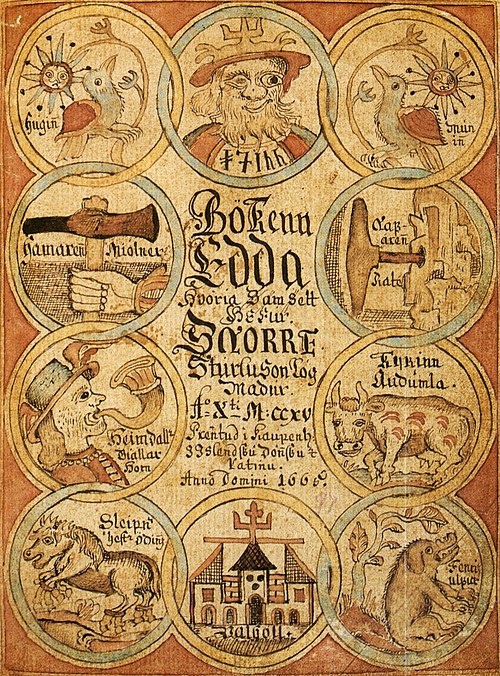
Title page of a late manuscript of the Prose Edda written by Snorri Sturluson (13th century), showing the Ancient Norse Gods Odin, Heimdallr, Sleipnir, and other figures from Norse mythology

Gylfi and High, Just-as-High, and Third. Manuscript SAM 66 (Iceland, 1765–1766), Reykjavík, Árni Magnússon Institute for Icelandic Studies.

Thjazi and Loki. Beginning of the myth of the abduction of Iðunn, attested in Skáldskaparmál. Manuscript NKS 1867 4to (Iceland, 1760), Copenhagen, Royal Library