Historically informed performance is an approach to the performance of classical music which aims to be faithful to the approach, manner and style of the musical era in which a work was originally con

Performance on period instruments is a key aspect of HIP, such as this baroque orchestra (Photo: Josetxu Obregón and the Spanish ensemble La Ritirata, 2013).

Historical collections of preserved instruments help researchers (St Cecilia's Hall, Edinburgh)

A Viola da gamba by Thomas Cole (c. 1680)

Countertenor Philippe Jaroussky, accompanied by Christina Pluhar in 2011 (theorbo)
Harpsichord
Videos
A harpsichord is a keyboard instrument that makes its sound by plucking a set of strings. In a harpsichord, depressing a key raises its back end within the instrument, which in turn lifts one or more
Historically informed performance
…such as Gardiner's Orchestre Révolutionnaire et Romantique have emerged. A variety of once obsolete keyboard instruments such as the clavichord and the harpsichord have been revived, as they have particular importance in the performance of Early music. Before the evolution of the symphony orchestra led by a…

This harpsichord is the work of two celebrated makers: originally constructed by Andreas Ruckers in Antwerp (1646), it was later remodeled and expanded in a process called grand ravalement by Pascal Taskin in Paris (1780).
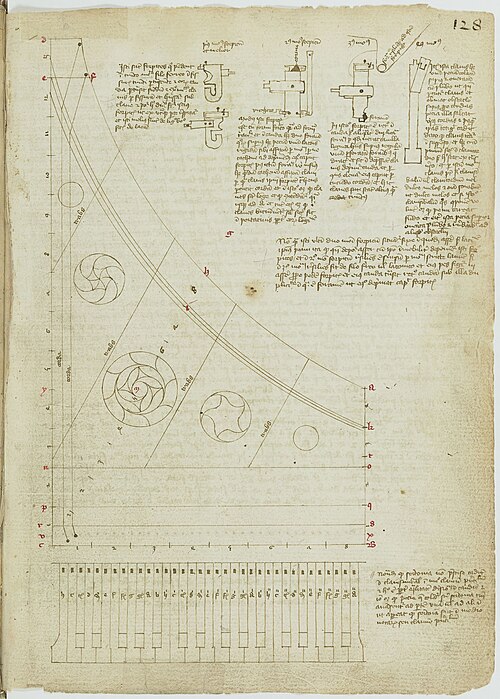
An early diagram of a vertical harpsichord (clavicytherium) by Arnault de Zwolle, c. 1430

Harpsichord by Christian Zell, at Museu de la Música de Barcelona. From upper left to lower right: a bridge (supporting the far ends of the strings), the jack rail with the action (jacks) underneath, two nuts (supporting the closer ends of the strings), interleaved with two rows of tuning pins, and finally the keyboard. As with all harpsichords, the action itself is mostly hidden by the jack rail when the instrument is being played; only by removing the jack rail (or indeed, by extracting a jack) can the details of the action be observed.

Sound board of a harpsichord with Chladni patterns