History of aviation
Videos
The history of aviation spans over two millennia, from the earliest innovations like kites and attempts at tower jumping to supersonic and hypersonic flight in powered, heavier-than-air jet aircraft.
French reconnaissance balloon L'Intrépide of 1796, the oldest existing flying device, in the Heeresgeschichtliches Museum, Vienna

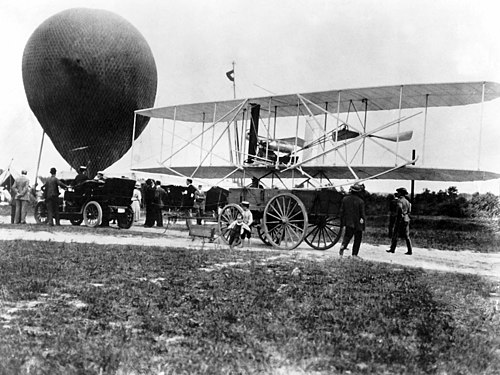
The Wright Military Flyer aboard a wagon in 1908

Leonardo da Vinci's ornithopter design

Daedalus working on Icarus' wings
Ornithopter
Videos
An ornithopter is an aircraft that flies by flapping its wings. Designers sought to imitate the flapping-wing flight of birds, bats, and insects. The term covers a wide range of possible designs. Orni
History of aviation
…neglected to make himself a tail. Many others made well-documented jumps in the following centuries. As late as 1811, Albrecht Berblinger constructed an ornithopter and jumped into the Danube at Ulm. The kite may have been the first form of man-made heavier-than-air aircraft. It was invented in China possibly as…

Leonardo da Vinci's ornithopter design

E.P. Frost's 1902 ornithopter

Otto Lilienthal on August 16, 1894, with his kleiner Schlagflügelapparat

Schmid 1942 Ornithopter