History of foreign relations of China
Videos
Photos
History of foreign relations of China covers diplomatic, military, political and economic relations in History of China from 1800 to the modern era. For the earlier period see Foreign relations of imperial China, and for the current foreign relations of China see Foreign relations of China.
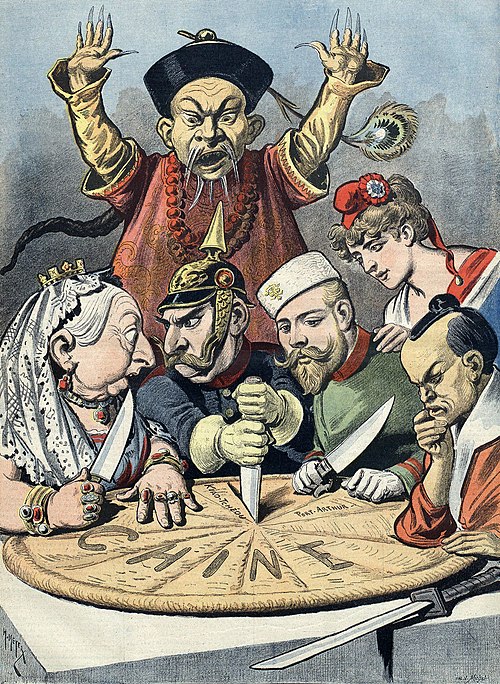
French political cartoon from 1898 depicts helpless China being carved up and divided among the great powers: Britain, Germany, Russia, France and Japan.

Sino-French War (1884-1885)

Chinese generals in Pyongyang surrender to the Japanese, October 1894.

British cartoon shows the victory of "little" Japan over "large" China. in 1894.
Foreign relations of imperial China
Videos
Photos
The foreign relations of Imperial China from the Qin dynasty until the Qing dynasty encompassed many situations as the fortunes of dynasties rose and fell. Chinese culture had influenced neighboring and distant countries, while being transformed by outside influences as well as being conquered. During the Western Han dynasty, the Silk Road trade routes were established and brought Hellenistic Central Asia, Persia under the Parthian Empire, and South Asia into contact with the Chinese empire. During the 2nd century BC, Zhang Qian became the first known Chinese diplomat to venture deep into Central Asia in search of allies against the Mongolic Xiongnu confederation. Han Chinese attempts were made at reaching the Roman Empire and although the mission led by Gan Ying in 97 AD was a failure, Chinese historical records nevertheless maintain that the Romans traveled to southern China and Vietnam via the Indian Ocean. Buddhism from India was introduced to China during the Eastern Han period and would spread to neighboring Vietnam, Korea, and Japan, all of which would adopt similar Confucian cultures based on the Chinese model.

The Yongle Emperor (r. 1402–1424). During his reign, Admiral Zheng He led a gigantic maritime tributary fleet abroad on the seven treasure voyages.

Statues of the Yungang Grottoes, one of many cultural symbols displaying China's embracement of Buddhism.

Prince Shōtoku (574–622) was a regent and a politician of the Imperial Court in Japan.

A painting portraying Emperor Taizong of the Tang dynasty by painter Yan Liben (c. 600–673).