Russo-Turkish wars or Russo-Ottoman wars were a series of twelve wars fought between the Russian Empire and the Ottoman Empire between the 16th and 20th centuries. It was one of the longest series of military conflicts in European history. Except for the war of 1710–11, as well as the Crimean War which is often treated as a separate event, the conflicts ended disastrously for the Ottoman Empire, which was undergoing a long period of stagnation and decline; conversely, they showcased the ascendancy of Russia as a European power after the modernization efforts of Peter the Great in the early 18th century.

Left to right from the top: Siege of Ochakov, Siege of Izmail, Siege of Sevastopol, Siege of Plevna, Battle of Sarikamish, Erzurum Offensive

Capture of Azov by the troops of Peter the Great in 1696
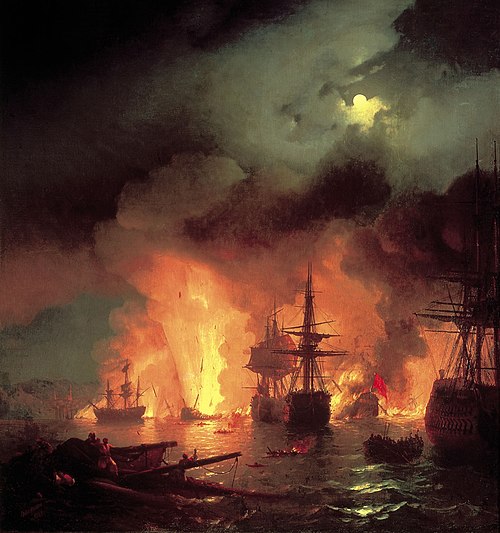
The destruction of the Ottoman fleet in Battle of Chesma

Russian siege of Varna in Ottoman-ruled Bulgaria, July–September 1828
Imperial Russian Navy
Videos
The Imperial Russian Navy operated as the navy of the Russian Tsardom and later the Russian Empire from 1696 to 1917. Formally established in 1696, it lasted until dissolved in the wake of the February Revolution of 1917. It developed from a smaller force that had existed prior to Tsar Peter the Great's founding of the modern Russian navy during the Second Azov campaign in 1696. It expanded in the second half of the 18th century and reached its peak strength by the early part of the 19th century, behind only the British and French fleets in terms of size.

Emblem of the Imperial Russian Navy

Goto Predestinatsia, flagship of the Azov flotilla until 1711

Russian fleet under the command of Admiral Fyodor Ushakov, sailing through the Bosphorus. By M. M. Ivanov

The naval cathedral in Kronstadt was one of several cathedrals of the Imperial Russian Navy.