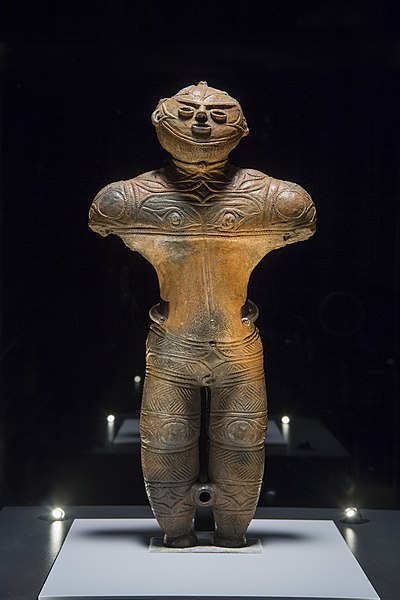
The so-called "Hollow Dogū" is a Japanese dogū or clay figurine of the Late Jōmon period. A chance find from what was to become the Chobonaino Site in Hakodate, Hokkaido, it is exhibited at the Hakodate Jōmon Culture Center. It is one of five dogū that have been designated National Treasures. The other four include "Dogū with palms pressed together" from Aomori Prefecture, "Jōmon Goddess" from Yamagata Prefecture, and "Jōmon Venus" and "Masked Goddess" from Nagano Prefecture. It is also the first and, to date, only National Treasure in Hokkaidō.
Hollow Dogū
Hakodate is a city and port located in Oshima Subprefecture, Hokkaido, Japan. It is the capital city of Oshima Subprefecture. As of January 31, 2024, the city had an estimated population of 239,813 with 138,807 households, and a population density of 354 persons per km². The total area is 677.86 square kilometres (261.72 sq mi). The city is the third biggest in Hokkaido after Sapporo and Asahikawa.
Clockwise from the top: Goryokaku, Hakodate Orthodox Church, Night View from Mount Hakodate, Goryokaku Tower, Hachiman-Zaka and Hakodate Port
Lithograph entitled "View of Hakodate from Snow Peak" looking towards the sea—artist, Wilhelm Heine (1856)
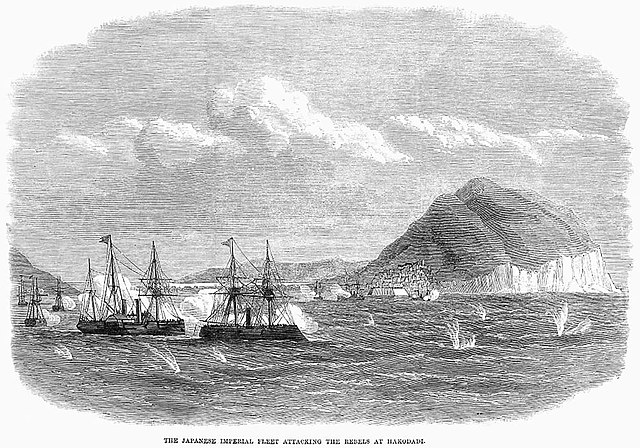
Naval Battle of Hakodate (1869)
Omachi, one of the neighborhoods in the Hakodate foreign settlement (1880)