Homology (biology)
Videos
In biology, homology is similarity in anatomical structures or genes between organisms of different taxa due to shared ancestry, regardless of current functional differences. Evolutionary biology expl
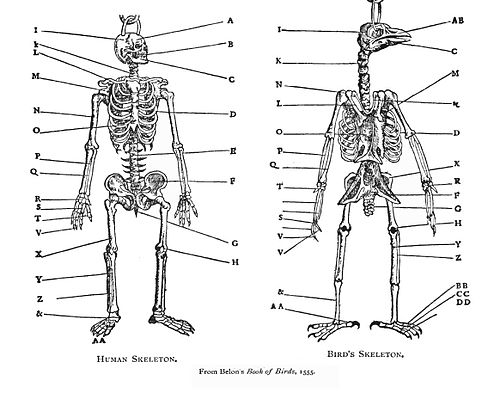
Pierre Belon systematically compared the skeletons of birds and humans in his Book of Birds (1555).

The front wings of beetles have evolved into elytra, hard wing-cases.

Dragonflies have the ancient insect body plan with two pairs of wings.

The hind wings of flies such as this cranefly have evolved divergently to form small club-like halteres.
Apomorphy and synapomorphy
Videos
In phylogenetics, an apomorphy is a novel character or character state that has evolved from its ancestral form. A synapomorphy is an apomorphy shared by two or more taxa and is therefore hypothesized
Homology (biology)
…arises only once on a tree is taken to be homologous. As implied in this definition, many cladists consider secondary homology to be synonymous with synapomorphy, a shared derived character or trait state that distinguishes a clade from other organisms. Shared ancestral character states, symplesiomorphies…

Phylogenies showing the terminology used to describe different patterns of ancestral and derived character or trait states.