Hubble Ultra-Deep Field
Videos
The Hubble Ultra-Deep Field is a deep-field image of a small region of space in the constellation Fornax, containing an estimated 10,000 galaxies. The original data for the image was collected by the
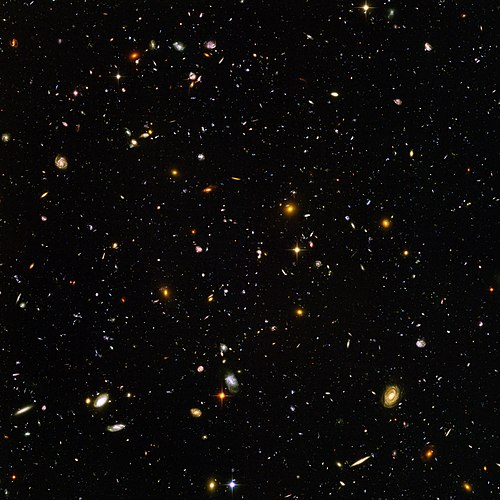
The original NASA release, containing about 10,000 galaxies of various ages, sizes, shapes, and colors. The smallest, reddest ones are some of the most distant galaxies to have been imaged by an optical telescope, probably existing shortly after the Big Bang.

Location of the Hubble Ultra-Deep Field on the sky

Spiral galaxy UDF 423 (visible-light)

Hidden to visible light, another object above the galaxy
Universe
Videos
The universe comprises all of existence: all forms of matter and energy, and the structures they form, from subatomic particles to entire galactic filaments. Since the early 20th century, the field of
Hubble Ultra-Deep Field
…using the newly available F105W, F125W and F160W infra-red filters (which correspond to the Y, J and H bands): The HUDF was the deepest image of the universe ever taken in 2004 and has been used to search for galaxies that existed less than a billion years after the Big Bang. Several galaxies in the HUDF are…

The Hubble Ultra-Deep Field image shows some of the most remote galaxies visible to present technology (diagonal is ~1/10 apparent Moon diameter)

In this schematic diagram, time passes from left to right, with the universe represented by a disk-shaped "slice" at any given time. Time and size are not to scale. To make the early stages visible, the time to the afterglow stage (really the first 0.003%) is stretched and the subsequent expansion (really by 1,100 times to the present) is largely suppressed.

The three possible options for the shape of the universe

The formation of clusters and large-scale filaments in the cold dark matter model with dark energy. The frames show the evolution of structures in a 43 million parsecs (or 140 million light-years) box from redshift of 30 to the present epoch (upper left z=30 to lower right z=0).