IAU definition of planet
Videos
The International Astronomical Union adopted in August 2006 the definition made by Uruguayan astronomers Julio Ángel Fernández and Gonzalo Tancredi which stated that, in the Solar System, a planet is

The original proposal would have immediately added three planets, shown here in a size comparison to Earth. Leftmost is Pluto (shown in lieu of Eris, which is about the same size), then Charon, Ceres, and Earth

The twelve "candidate planets" that were possibilities for inclusion under the originally proposed definition. Note that all but the last three are trans-Neptunian objects. The smallest three (Vesta, Pallas, Hygiea) are in the asteroid belt.

Plenary session of the IAU General Assembly on August 24, 2006. Votes were cast by raising yellow cards.
Planet
Videos
A planet is a large, rounded astronomical body that is generally required to be in orbit around a star, stellar remnant, or brown dwarf, and is not one itself. The Solar System has eight planets by th
IAU definition of planet
…adopted in August 2006 the definition made by Uruguayan astronomers Julio Ángel Fernández and Gonzalo Tancredi which stated that, in the Solar System, a planet is a celestial body that: is in orbit around the Sun…
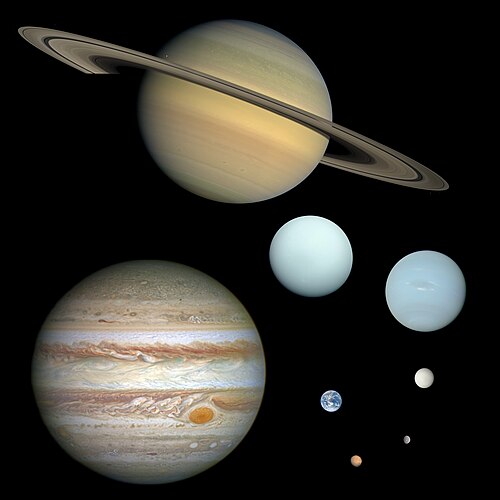
The eight planets of the Solar System with size to scale (up to down, left to right): Saturn, Jupiter, Uranus, Neptune (outer planets), Earth, Venus, Mars, and Mercury (inner planets)

A protoplanetary disk

Protoplanets colliding during planet formation

Earth's atmosphere