IBM 305 RAMAC
Videos
The IBM 305 RAMAC was the first commercial computer that used a moving-head hard disk drive for secondary storage. The system was publicly announced on September 14, 1956, with test units already installed at the U.S. Navy and at private corporations. RAMAC stood for "Random Access Method of Accounting and Control", as its design was motivated by the need for real-time accounting in business.

IBM 305 RAMAC system: IBM 305 main system (Processing unit, magnetic process drum, magnetic core register, electronic logical and arithmetic circuits) IBM 370 printer (left), IBM 380 console (right)

One RAMAC storage disk showing head crash damage

IBM 305 at U.S. Army Red River Arsenal. Foreground: two 350 disk drives. Background: 380 console and 305 processing unit

RAMAC mechanism at Computer History Museum
Disk storage
Videos
Disk storage is a data storage mechanism based on a rotating disk. The recording employs various electronic, magnetic, optical, or mechanical changes to the disk's surface layer. A disk drive is a device implementing such a storage mechanism. Notable types are hard disk drives (HDD), containing one or more non-removable rigid platters; the floppy disk drive (FDD) and its removable floppy disk; and various optical disc drives (ODD) and associated optical disc media.

Six hard disk drives
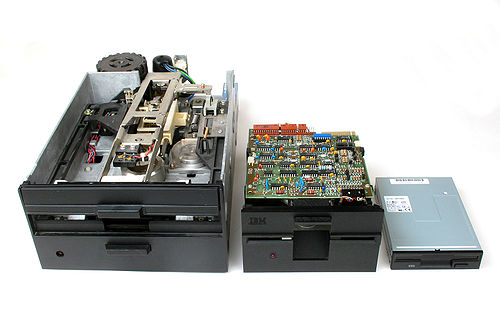
Three floppy disk drives

A CD-ROM (optical) disc drive