IPCC Third Assessment Report
Videos
The IPCC Third Assessment Report, Climate Change 2001, is an assessment of available scientific and socio-economic information on climate change by the IPCC. Statements of the IPCC or information from
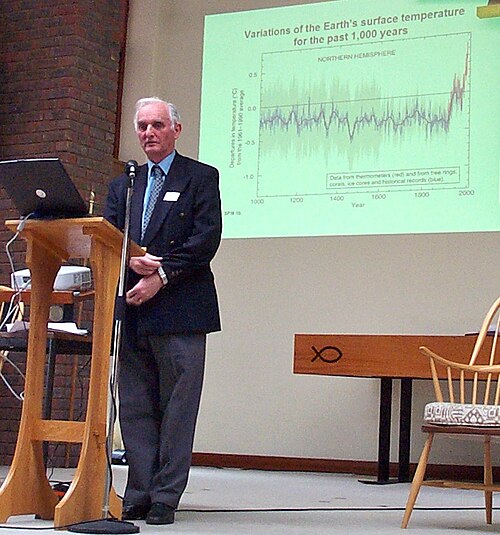
IPCC WG1 co-chair Sir John T. Houghton showing the IPCC fig. 2.20 hockey stick graph at a climate conference in 2005

The original northern hemisphere hockey stick graph of Mann, Bradley & Hughes 1999, smoothed curve shown in blue with its uncertainty range in light blue, overlaid with green dots showing the 30-year global average of the PAGES 2k Consortium 2013 reconstruction. The red curve shows measured global mean temperature, according to HadCRUT4 data from 1850 to 2013.
Greenhouse gas
Videos
Greenhouse gases are the gases in an atmosphere that trap heat, raising the surface temperature of astronomical bodies such as Earth. Unlike other gases, greenhouse gases absorb the radiations that a
Comparison of global warming potential of three greenhouse gases over a 100-year period (GWP-100) per ton: Perfluorotributylamine (PFTBA), nitrous oxide and methane, compared to carbon dioxide (the latter is the reference value, therefore it has a GWP of one). PFTBA is here used as an example of a larger group of potent fluorinated greenhouse gases. Fluorinated hydrocarbons combined contribute about 10% to global warming.


This 1912 article succinctly describes how burning coal creates carbon dioxide that causes climate change.