Indian Rebellion of 1857
Videos
The Indian Rebellion of 1857 was a major uprising in India in 1857–58 against the rule of the British East India Company, which functioned as a sovereign power, including military forces, on behalf of

India in 1765 and 1805, showing East India Company-governed territories in pink

India in 1837 and 1857, showing East India Company-governed territories in pink

Two sepoy officers and a private, 1820s

Charles Canning, 1st Earl Canning, the Governor-General of India during the rebellion.
British Raj
Videos
The British Raj was the period of rule of the British Crown on the Indian subcontinent, lasting from 1858 to 1947. It is also called Crown rule in India, or direct rule in India. The region under Brit
Indian Rebellion of 1857
…administration in India through passage of the Government of India Act 1858. India was thereafter administered directly by the British government in the new British Raj. On 1 November 1858, Queen Victoria issued a proclamation to Indians, which, while lacking the authority of a constitutional provision, promised rights…
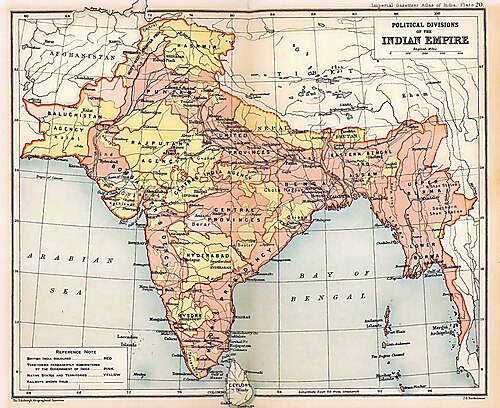
Political subdivisions of the British Raj in 1909. British India is shown in two shades of pink; Sikkim, Nepal, Bhutan, and the princely states are shown in yellow.

The British Raj and surrounding countries are shown in 1909

The British Raj in relation to the British Empire in 1909

Lakshmibai, Rani of Jhansi, one of the principal leaders of the Great Uprising of 1857, who had lost her kingdom by the Doctrine of lapse