Indra's net
Videos
Indra's net is a metaphor used to illustrate the Buddhist philosophical concepts of Śūnyatā, pratītyasamutpāda, and perfect interpenetration in East Asian Buddhism.

A 3d rendering depicting the Indra's net metaphor

Liao dynasty statue of the Eleven Headed Guanyin in Dule Temple in Tianjin, China.

"Imagine a multidimensional spider's web in the early morning covered with dew drops. And every dew drop contains the reflection of all the other dew drops. And, in each reflected dew drop, the reflections of all the other dew drops in that reflection. And so ad infinitum. That is the Buddhist conception of the universe in an image." –Alan Watts
Indra
Videos
Indra is the Vedic god of weather, considered the king of the devas and the realm of Svarga in Hinduism. He is associated with the sky, lightning, weather, thunder, storms, rains, river flows, and war
Indra's net
…Buddhāvataṃsaka Sūtra and later by the Huayan school between the 6th and 8th centuries. "Indra's net" is an infinitely-large net owned by the Vedic deva Indra, which hangs over his palace on Mount Meru, the axis mundi of Buddhist and Hindu cosmology. In East Asian Buddhism, Indra's net is considered as having…
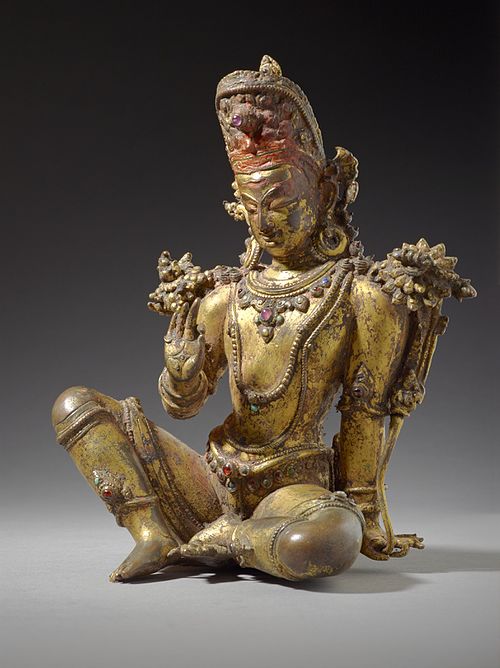
A gilt-copper sculpture of Indra, c. 16th-century

Indra on his elephant, guarding the entrance of the 1st century BCE Buddhist Cave 19 at Bhaja Caves (Maharashtra).

Banteay Srei temple's pediment carvings depict Indra mounted on Airavata, Cambodia, c. 10th century.

Indra is typically featured as a guardian deity on the east side of a Hindu temple.