Indus Valley Civilisation
Videos
The Indus Valley Civilisation, also known as the Indus Civilisation, was a Bronze Age civilisation in the northwestern regions of South Asia, lasting from 3300 BCE to 1300 BCE, and in its mature form
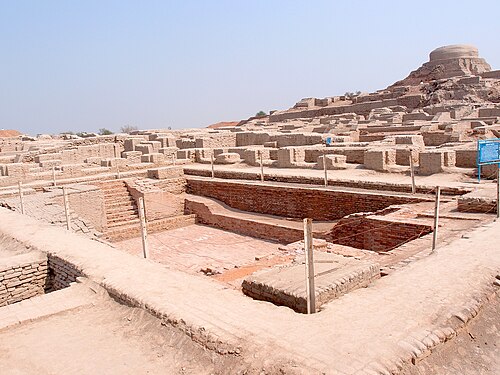
Ruins of Mohenjo-daro on the Indus River in Pakistan, the first South Asian UNESCO World Heritage Site; the Great Bath is in the foreground.

Miniature votive images or toys from Harappa, c. 2500 BCE, clay figurines of zebu oxen, a cart, and a chicken.
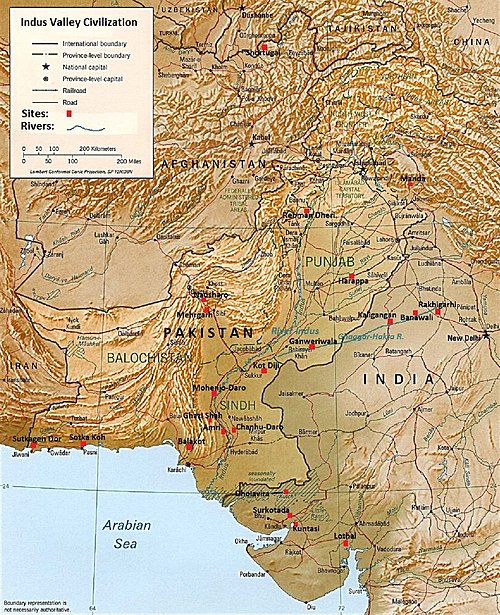
Major sites and extent of the Indus Valley Civilisation

Alexander Cunningham, the first director general of the Archaeological Survey of India (ASI), interpreted a Harappan stamp seal in 1875.
Indus script
Videos
The Indus script, also known as the Harappan script and the Indus Valley script, is a corpus of symbols produced by the Indus Valley Civilisation. Most inscriptions containing these symbols are extrem
Indus Valley Civilisation
…Dholavira: A Harappan City"), and Rakhigarhi in Haryana. The Harappan language is not directly attested, and its affiliations are uncertain, as the Indus script has remained undeciphered. A relationship with the Dravidian or Elamo-Dravidian language family is favoured by a section of scholars. The Indus Valley…

Three stamp seals and their impressions bearing Indus script characters alongside animals: "unicorn" (left), bull (centre), and elephant (right); Guimet Museum, Paris

"Unicorn" seal with Indus inscription, and a modern impression; Met Museum

Collection of seals and their impressions; British Museum

A proposed connection between the Brahmi and Indus scripts, made in the 19th century by Alexander Cunningham, an early proponent for the hypothesis of an indigenous origin of Brahmi