International Joint Commission
The International Joint Commission is a bi-national organization established by the governments of the United States and Canada under the Boundary Waters Treaty of 1909. Its responsibilities were expanded with the signing of the Great Lakes Water Quality Agreement of 1972. The commission deals with issues affecting the extensive waters and waterways along the Canada–United States border.
Sections of Canada and the United States (including in the Boundary Waters Canoe Area Wilderness, above) are separated by a boundary that is in water. A particularly extensive section of the Canada–US border is in the Great Lakes.
The movement of the water near Niagara Falls on the border, is used to generate substantial hydroelectricity
Canada–United States border
The Canada–United States border is the longest international border in the world. The boundary is 8,891 km (5,525 mi) long. The land border has two sections: Canada's border with the contiguous United States to its south, and with the U.S. state of Alaska to its west. The bi-national International Boundary Commission deals with matters relating to marking and maintaining the boundary, and the International Joint Commission deals with issues concerning boundary waters. The agencies responsible for facilitating legal passage through the international boundary are the Canada Border Services Agency (CBSA) and U.S. Customs and Border Protection (CBP).
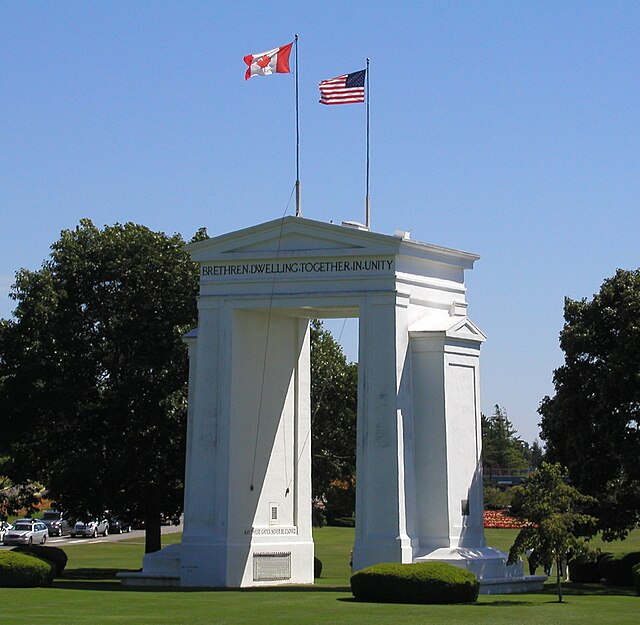
The Peace Arch at the border between Surrey, British Columbia, and Blaine, Washington
Signing of the Treaty of Ghent in 1814, which ended the War of 1812 and returned the border to its pre-war state. Subsequent treaties agreed upon saw the border demilitarized, and most boundary disputes resolved.
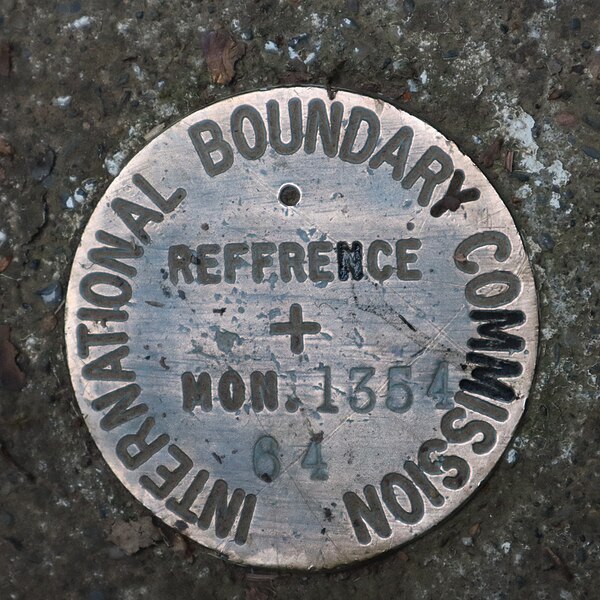
An International Boundary Commission reference monument at the Pigeon River
The Poker Creek–Little Gold Creek Border Crossing at the Alaska–Yukon border closed as a result of the COVID-19 pandemic.