Interstellar travel
Videos
Interstellar travel is the hypothetical travel of spacecraft from one star system, solitary star, or planetary system to another. Interstellar travel is expected to prove much more difficult than interplanetary spaceflight due to the vast difference in the scale of the involved distances. Whereas the distance between any two planets in the Solar System is less than 55 astronomical units (AU), stars are typically separated by hundreds of thousands of AU, causing these distances to typically be expressed instead in light-years. Because of the vastness of these distances, non-generational interstellar travel based on known physics would need to occur at a high percentage of the speed of light; even so, travel times would be long, at least decades and perhaps millennia or longer.

A Bussard ramjet, one of many possible methods that could serve to propel spacecraft

Modern Pulsed Fission Propulsion Concept
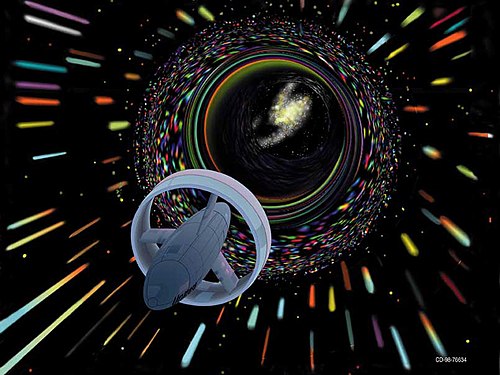
Artist's depiction of a hypothetical Wormhole Induction Propelled Spacecraft, based loosely on the 1994 "warp drive" paper of Miguel Alcubierre
Alpha Centauri
Videos
Alpha Centauri is a triple star system in the southern constellation of Centaurus. It consists of three stars: Rigil Kentaurus, Toliman (B) and Proxima Centauri (C). Proxima Centauri is the closest star to the Sun at 4.2465 light-years.

Alpha Centauri AB (left) forms a triple star system with Proxima Centauri, circled in red. The bright star system to the right is Beta Centauri.

View of Alpha Centauri from the Digitized Sky Survey-2

Alpha Centauri A (left) is of the same stellar type G2 as the Sun, while Alpha Centauri B (right) is a K1-type star.

Looking towards the sky around Orion from Alpha Centauri with Sirius near Betelgeuse, Procyon in Gemini, and the Sun in Cassiopeia generated by Celestia.