Io (moon)
Videos
Io is the innermost and second smallest of the four Galilean moons of Jupiter. Slightly larger than Earth's Moon, Io is the fourth-largest natural satellite in the Solar System, has the highest densit
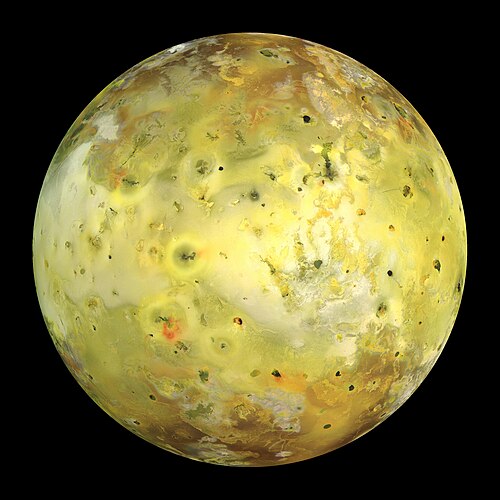
Enhanced color image of Io from the Galileo spacecraft, taken in 1999.

Voyager 1 mosaic covering Io's south polar region. This includes two of Io's ten highest peaks, the Euboea Montes at upper extreme left and Haemus Mons at bottom.

Enhanced-color Galileo image showing a dark spot (just lower-left of center, interrupting the red ring of short-chain sulfur allotropes deposited by Pele) produced by a major eruption at Pillan Patera in 1997

Io as seen by JunoCam on 3 February 2024. Its night side is illuminated by the reflected sunlight from Jupiter.
Jupiter
Videos
Jupiter is the fifth planet from the Sun, and the largest in the Solar System. It is a gas giant with a mass nearly 2.5 times that of all the other planets in the Solar System combined and slightly le
Io (moon)
…Io () is the innermost and second smallest of the four Galilean moons of Jupiter. Slightly larger than Earth's Moon, Io is the fourth-largest natural satellite in the Solar System, has the highest density and strongest surface gravity…

Close-up of the Great Red Spot imaged by the Juno spacecraft in true colour. Due to the way Juno takes photographs, the stitched image has extreme barrel distortion.

The Galilean moons' effect on Jupiter's magnetosphere

Jupiter and four Galilean moons seen through an amateur telescope

Jupiter, taken in infrared light, showing its faint rings, along with two moons – Amalthea and Adrastea, auroras, and atmospheric features.