Io (mythology)
Videos
In Greek mythology, Io was one of the mortal lovers of Zeus. An Argive princess, her descendants included Perseus, Cadmus, Heracles, Minos, Lynceus, Cepheus, Dionysus, and Danaus. The astronomer Simon

Io wearing bovine horns watched over by Argos on Hera's orders, antique fresco from Pompeii

Juno Discovering Jupiter with Io by Pieter Lastman

Terracotta antefix with the head of Io, 4th century BCE (Brindisi, Museo archeologico Francesco Ribezzo)

Io Recognised by Her Father by Victor Honoré Janssens (second half of 17th century)
Io (moon)
Videos
Io is the innermost and second smallest of the four Galilean moons of Jupiter. Slightly larger than Earth's Moon, Io is the fourth-largest natural satellite in the Solar System, has the highest densit
Io (mythology)
…Argive princess, her descendants included Perseus, Cadmus, Heracles, Minos, Lynceus, Cepheus, Dionysus, and Danaus. The astronomer Simon Marius named a moon of Jupiter after Io in 1614. The Ionian Islands are also named after Io (not to be confused with the ancient region of Ionia which was named after Ion…
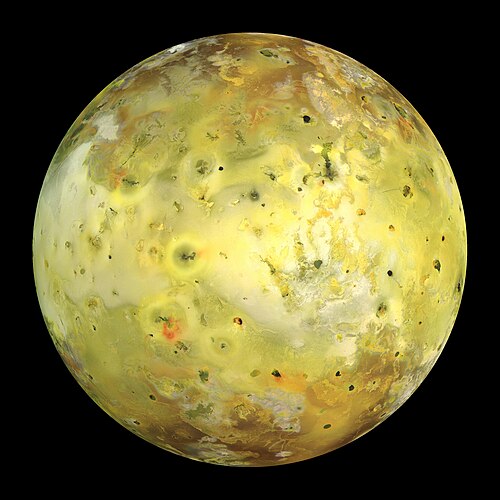
Enhanced color image of Io from the Galileo spacecraft, taken in 1999.

Voyager 1 mosaic covering Io's south polar region. This includes two of Io's ten highest peaks, the Euboea Montes at upper extreme left and Haemus Mons at bottom.

Enhanced-color Galileo image showing a dark spot (just lower-left of center, interrupting the red ring of short-chain sulfur allotropes deposited by Pele) produced by a major eruption at Pillan Patera in 1997

Io as seen by JunoCam on 3 February 2024. Its night side is illuminated by the reflected sunlight from Jupiter.