Iranians in China
Videos
Iranian people, such as Persians and Sogdians, have lived in China throughout various periods in history.

Detail of the stone panel painting on the sarcophagus, depicting two nimbate male figures dressing in Sasanian-style attire, drinking wine and playing pipa. Tomb of Yu Hong, 6th century CE.

Left: a man holding a plate of fruits; right: a bearded man is performing the Huteng ("Barbarian leap") dance. Both figures have haloes. Tomb of Yu Hong, 6th century CE.

Persian ambassador at the Chinese court of Emperor Yuan of Liang in his capital Jingzhou in 526-539 CE, with explanatory text. Portraits of Periodical Offering of Liang, 11th century Song copy.

Tang-dynasty foreigner. Shaanxi History Museum, Xi'an
Sogdia
Videos
Sogdia or Sogdiana was an ancient Iranian civilisation located between the Amu Darya and the Syr Darya rivers, in what is now Uzbekistan, Turkmenistan, Tajikistan, Kazakhstan, and Kyrgyzstan. Sogdiana
Iranians in China
…Iranian people, such as Persians and Sogdians, have lived in China throughout various periods in history. The Parthian Iranian An Shigao introduced Hinayana Buddhism to China, while the Kushan…
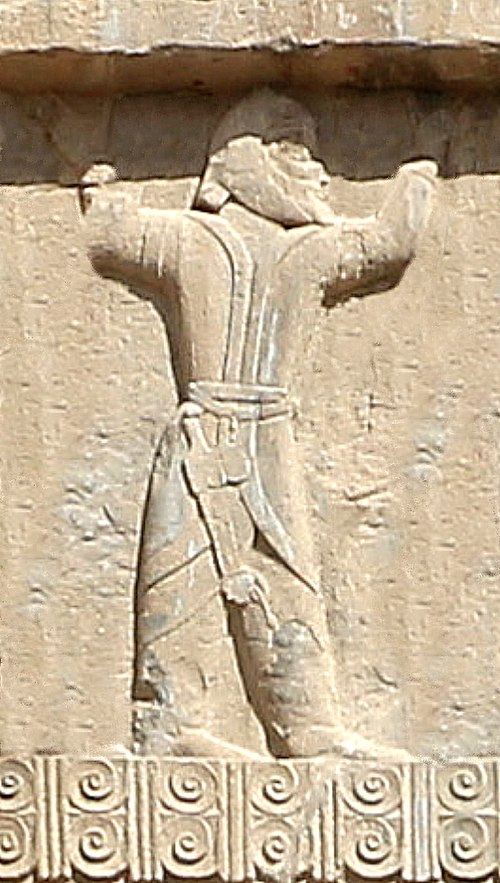
Sogdian soldier circa 338 BCE, tomb of Artaxerxes III.

Sogdians on an Achaemenid Persian relief from the Apadana of Persepolis, offering tributary gifts to the Persian king Darius I, 5th century BC

Head of a Saka warrior, as a defeated enemy of the Yuezhi, from Khalchayan, northern Bactria, 1st century BCE.

A Yuezhi (left) fighting a Sogdian behind a shield (right), Noin-Ula carpet, 1st century BC/AD.