Iris (anatomy)
Videos
The iris is a thin, ring-shaped structure in the eye in most mammals and birds that is responsible for controlling the diameter and size of the pupil, and thus the amount of light reaching the retina.

The iris in humans is the colored (typically brown, blue, or green) area, with the pupil (the circular black spot) in its center, and surrounded by the white sclera.

The iris (brown coloured portion of the eye) controls the size of the pupil by contracting the sphincter pupillae and dilator pupillae muscles.

Light micrograph of the iris near to the pupil. M. sph. sphincter muscle, L lens
![Among human phenotypes, blue-green-gray eyes are a relatively rare[citation needed] eye color and the exact color is often perceived to vary according](https://upload.wikimedia.org/wikipedia/commons/thumb/0/0c/Ageev_iris.jpg/500px-Ageev_iris.jpg)
Among human phenotypes, blue-green-gray eyes are a relatively rare[citation needed] eye color and the exact color is often perceived to vary according to its surroundings.
Pupil
Videos
The pupil is a hole located in the center of the iris of the eye that allows light to strike the retina. It appears black because light rays entering the pupil are either absorbed by the tissues insid
Iris (anatomy)
…irides or irises) is a thin, ring-shaped structure in the eye in most mammals and birds that is responsible for controlling the diameter and size of the pupil, and thus the amount of light reaching the retina. In optical terms, the pupil is the eye's aperture, while the iris is the diaphragm. Eye color is…
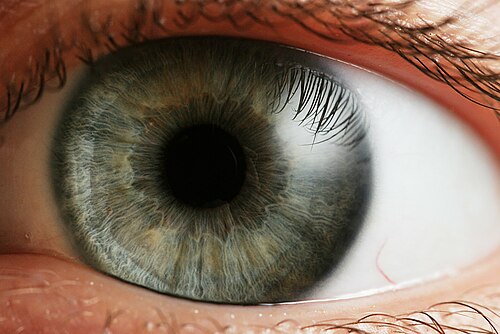
The pupil is the central opening of the iris on the inside of the eye, which normally appears black. The grey/blue or brown area surrounding the pupil is the iris. The white outer area of the eye is the sclera. The central outermost transparent colorless part of the eye (through which we can see the iris and pupil) is the cornea.

Pupil dilated naturally to 9 mm due to dim light. The subject is an extreme case, as most individuals are not able to naturally dilate their pupils to that extent

Pupil constriction can be in response to negative emotional states